



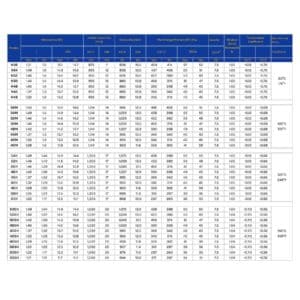
Thickness down to 0.5mm, High-Grade N52
We supply extreme micro-slicing of Neodymium Thin Discs.
Capable of achieving thicknesses as low as 0.50mm.
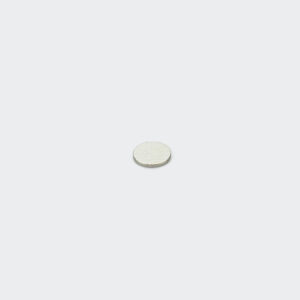
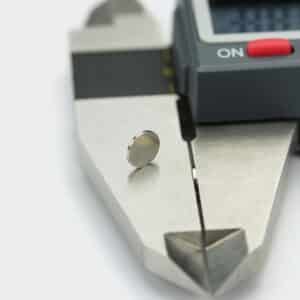
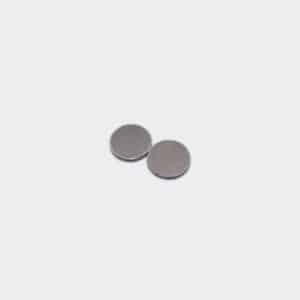
As shown in the product photo, these magnets are quite thin.
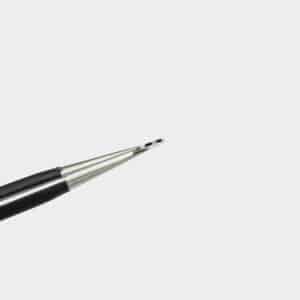
Handling them requires precision tweezers and a steady hand.
These “Micro-Wafers” are suitable for low profile applications.
Such as membrane switches, fiber optic isolators, and smart-card electronics.
Their vertical Z-height is the ultimate constraint.
These Sintered Neodymium retain high magnetic energy despite their microscopic volume.
Why 0.5mm?
At this scale, the magnet is a precision component, not just a fastener.
1. Z-Height Minimization:
The Application:
Smartphone camera modules, micro-speakers, and smart cards.
The Logic:
Modern electronics fight for every micron of space.
A 0.5mm magnet allows you to add magnetic function (sensing or actuation).
And not adding bulk to the device stack-up.
2. Hall Effect Sensing:
The Application:
Non-contact switching.
The Benefit:
A thin disc placed on a membrane button can trigger a Hall Effect sensor underneath.
Not interfering with the tactile “click” feel of the button.
3. “Foil” vs. Sintered:
The Distinction:
Do not confuse these with flexible magnetic sheets (fridge magnets).
These are Sintered Rare Earth.
Even at 0.5mm, an N52 disc provides a sharp, powerful magnetic field that flexible rubber magnets cannot match.
Manufacturing Advisory: Fragility & Physics
A 0.2mm magnet is brittle like a potato chip made of glass.
1. The “Flex” Warning:
The Risk:
Sintered Neodymium has zero flexibility.
If you try to bend this 0.5mm disc, it will snap instantly.
Assembly:
These magnets must be bonded to a Rigid Backing (Steel or Stiff Plastic) immediately.
They cannot be used as structural bridges.
2. The Pc Value (Heat Sensitivity):
The Physics:
A very thin magnet (low aspect ratio) has a poor “Permeance Coefficient.”
It is naturally fighting its own magnetic field.
The Heat Risk:
Because of this “magnetic stress,” thin wafers demagnetize easily at high temperatures.
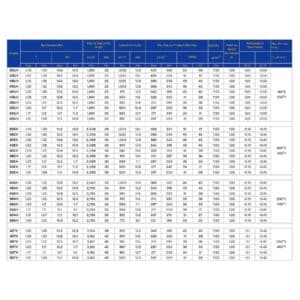
A standard N52 thin disc may fail at 60°C.
Our Solution:
For hot environments, we recommend upgrading to UH (Ultra High).
Or EH grades to stabilize the flux.
Handling & Packaging
How we ship them matters as much as how we make them.
1. Vacuum Wafer Packing:
The Method:
We do not ship these in bulk bags (they would crush each other).
We ship them in Vacuum-Sealed Trays or rigid slots, similar to semiconductor wafers.
Separation:
You cannot slide these apart by hand.
You must use non-magnetic tweezers (ceramic/plastic) to peel them from the stack.
2. Static Control:
The Advice:
At 0.5mm / 1mm size, static electricity is often stronger than the magnet’s weight.
Use anti-static tools to prevent the magnet from jumping or getting lost.
Ideal Applications
Micro-Optics: Faraday isolators in laser diodes.
MEMS: Micro-Electro-Mechanical Systems actuation.
Smart Wearables: Ultra-thin charging contacts.
Tactile Domes: Magnetic triggers inside membrane keypads.
Ordering Guide: Precision Specs
To quote these accurately, please specify:
1). Dimensions: Diameter x Thickness (e.g., 2mm x 0.5mm).
2). Coating:
– Parylene: (Best for thickness control and medical use).
– Nickel: (Standard, but adds ~0.03mm to the thickness).
3). Flatness: “Is this a sensor target?”
– We can sort for superior flatness.
4). Quantity: Batch production is required for micro-slicing.

Reviews
There are no reviews yet.