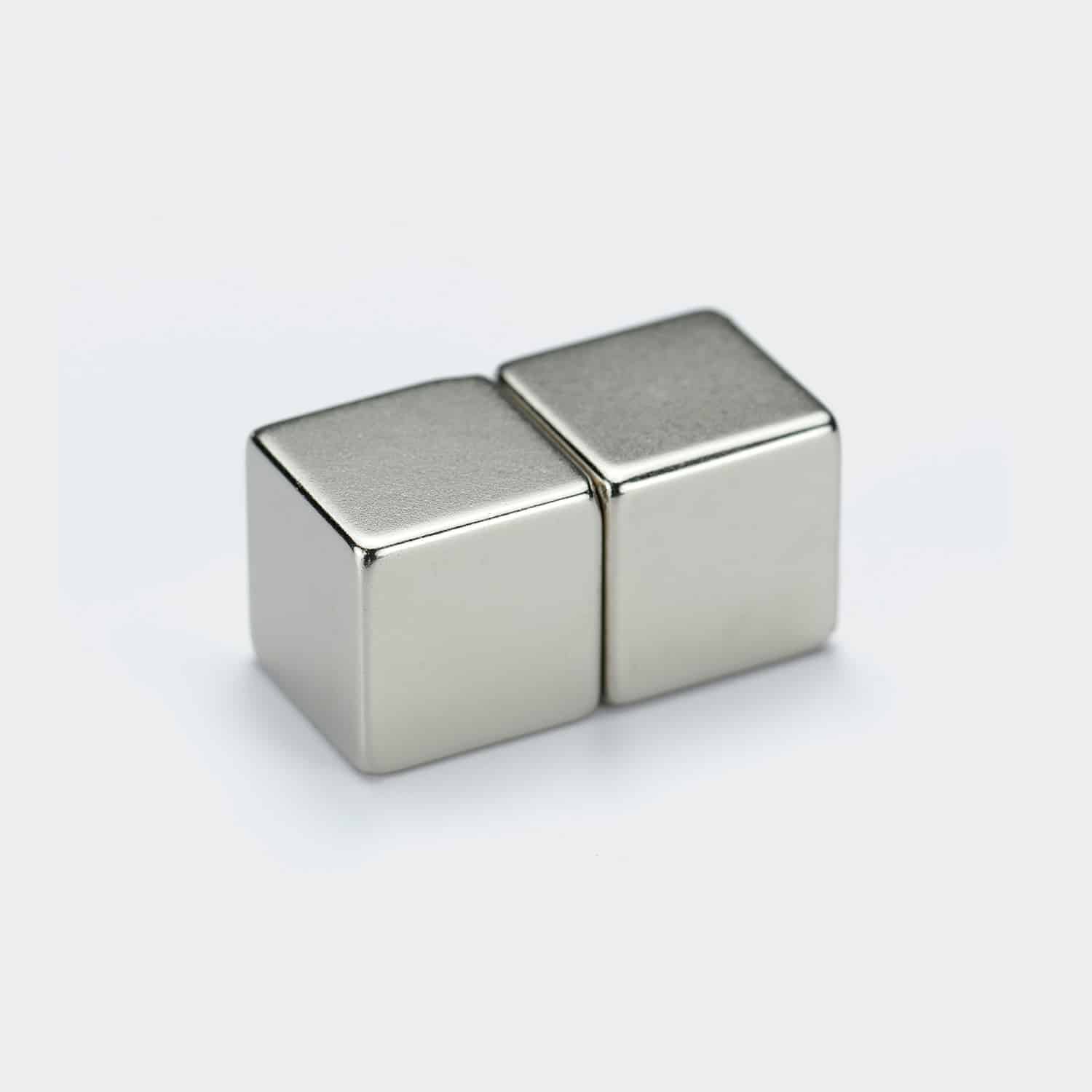
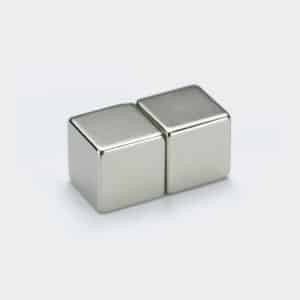
We offer Custom Neodymium Cube Magnets in high-performance Grade N50.
A perfect cube offers unique magnetic versatility.
A cube has uniform dimensions (L=W=H).
This allows it to be rotated and re-oriented 90° within a housing or array.
But won’t change the physical footprint.
The magnet grade N50 offers nearly the maximum energy product available (approx. 50 MGOe).
These N50 cubes are fit for applications requiring extreme magnetic flux in a compact, symmetrical form factor.
Why Use a Cube Magnet?
Cubes are chosen for specific magnetic configurations, not just aesthetics.
1. Modular Assemblies (Halbach Arrays):
The Application: Building a linear motor, a magnetic bearing, or a focusing array.
The Advantage:
– Cubes are the building blocks of Halbach Arrays.
– Their dimensions are identical.
– You can stack them with rotating magnetization vectors (Up, Right, Down, Left).
– They will focus the magnetic field on one side and cancel it on the other.
2. 3D Sensing & Positioning:
The Advantage:
– In multi-axis sensor setups, a cube allows for precise detection in X, Y, and Z planes.
– This depends on how the sensor is positioned relative to the magnet’s faces.
3. “Plug-and-Play” Research:
The Advantage:
– For R&D labs, cubes are ideal prototyping tools.
– You can easily flip the pole direction in a test fixture without needing a new magnet size.
Technical Advisory: The Size Limit
Physics imposes a limit on how large a Neodymium cube can be.
The “60mm Saturation” Rule:
We can manufacture cubes of any size, up to a maximum of 60mm x 60mm x 60mm.
To magnetize Sintered Neodymium, we must expose it to a massive magnetic pulse (saturation field) via a copper coil.
The Limit:
– For a solid block of N50 material, if the thickness exceeds 60mm, the magnetic pulse cannot fully penetrate to the core of the magnet.
– This results in a “soft” center and lower-than-rated performance.
Our Advice:
– If you need a magnetic mass larger than a 60mm cube, we recommend building it from Segmented Blocks (laminated layers).
– This magnetic assembly will ensures full saturation and safety.
Manufacturing Excellence: Orientation & Handling
1. Pole Identification (The “Blind” Cube):
The Problem:
– On a perfectly machined cube, it is visually impossible to tell which faces are the North/South poles.
– And also impossible to tell which are the neutral sides.
Our Solution:
– We provide Pole Marking as a standard service for custom cubes.
– We can mark the North Pole with a Red Dot or Laser Etch an arrow indicating flux direction.
– This is critical for preventing assembly errors.
2. Chamfering for Safety:
The Risk:
An N50 Cube is heavy and powerful.
If two cubes slam together, sharp 90° corners will chip or shatter, sending shrapnel flying.
Our Spec:
We apply a generous R-radius (Chamfer) to all 12 edges and 8 corners.
This protects the magnet from impact damage and protects your assembly workers from cuts.
Ideal Applications
Scientific Research: Particle physics experiments and magnetic field molding.
Magnetic Art & Sculpture: “Levitating” sculptures relying on repelling forces.
Industrial Separation: High-flow grate magnets (often using cube arrays).
Magnetic Jigs: Quick-change workholding fixtures where the magnet can be rotated to turn “Off” (by shunting) and “On.”
Ordering Guide: Define Your Cube
To receive a quote, please specify:
1). Side Length: (e.g., 10mm, 25.4mm, 50mm).
2). Marking: “Do you need the North Pole marked?” (Highly recommended).
3). Coating: Ni-Cu-Ni (Silver) is standard.
4). Quantity: (Low volume R&D orders are welcome).