

We supply custom octagonal Neodymium frame magnets.
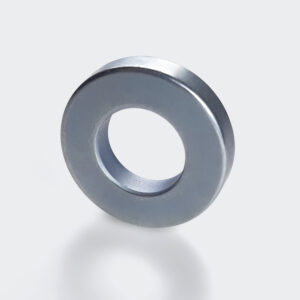
They have flat ring magnets with an eight-sided outer profile.
And a large central aperture, creating a thin-walled perimeter magnet.
The octagonal outer shape is created by chamfering or clipping the four corners of a square frame.
Such production techniques allow the magnet to fit into chamfered recesses.
Or reduce sharp corner stress points.
The central aperture permits the magnet to surround a functional component.
Such as a camera module, sensor array, display screen, or connector assembly.
Frame magnets are used for perimeter retention, alignment.
Or sealing where the center must remain unobstructed.
They are commonly used in consumer electronics, wearable devices, small displays, and modular assemblies.
The frame is typically produced by wire EDM or laser cutting from a solid block or ring magnet.
Wire EDM offers tighter tolerances (±0.05mm to ±0.1mm) but is slower.
Laser cutting is faster but may produce wider kerfs and require secondary finishing.
Minimum wall thickness is typically 1.5mm to 2mm.
The purpose is to prevent cracking during handling or installation.
Very thin walls increase fragility and coating difficulty.
Inner and outer edges may be chamfered to reduce chipping.
The Engineering Logic: Why this Shape?
This explains why the customer needs this specific geometry.
1. Housing Integration (The “Corner Cut”):
The Problem:
– Fitting a rectangular frame into a rounded device housing (like a smartwatch or lens barrel).
The Solution:
– The chamfered (clipped) corners reduce the diagonal footprint.
– This allows the magnet to fit into tight, non-square spaces.
– In such spaces, a sharp 90° corner would interfere with the housing wall or screw bosses.
2. The “Perimeter” Function:
The Function:
– By placing the magnetic mass only at the edges (the frame), you create a “Window.”
The Benefit:
– This is perfect for Magnetic Gaskets or Screen Bezels.
– It holds the mating part firmly around the edges.
– Meanwhile, leaves the center completely open for light, signals, or wires to pass through.
Manufacturing Note: “Hoop Strength” & Fragility
This is the most critical advice.
A thin magnet frame is as fragile as a potato chip.
Structural Integrity:
– The magnet in the photo has a very Thin Wall Thickness relative to its diameter.
The Risk:
– Sintered Neodymium is brittle.
– A thin frame like this has very low “Hoop Strength.”
– If you squeeze it or try to press-fit it, it will snap at the corners.
The Solution:
Inner Radii:
– We ensure the inner corners of the hole have a small radius (R0.2mm+).
– Sharp inner corners create “Stress Risers” that cause cracks.
Assembly:
– These must be glued into a support channel.
– Do not rely on them to bear structural load.
Surface Coatings
Nickel (Ni-Cu-Ni):
– As shown by the main product photo.
– Standard.
Black Epoxy:
– Highly recommended for consumer electronics (phones/tablets) to hide the magnet behind glass or plastic.
Parylene:
– Recommended if the frame serves as a gasket seal (waterproof).
Applications
Camera Modules: A magnetic ring around a smartphone lens to attach external filters.
Display Bezels: Holding a small LCD screen in place.
Connector Ports: The frame around a USB or charging port to guide a magnetic cable.
Hermetic Seals: Compressing an O-ring around a square opening.
Ordering Guide: The “Frame” Dimensions
To quote this, we need to map the geometry carefully.
Please provide:
1). Outer Dimensions: Length x Width.
2). Inner Dimensions: Length x Width of the hole.
3). Chamfer Size: The length of the corner cut (e.g., C2mm).
4). Thickness: The height.
5). Assembly: “Will this be glued into a recess?”
– If yes, we can suggest glue-gap tolerances.