
We supply precision-cut custom Triangular Neodymium Magnets.
They are common components for specialized sensor housings, modular magnetic assemblies, and creative design applications.
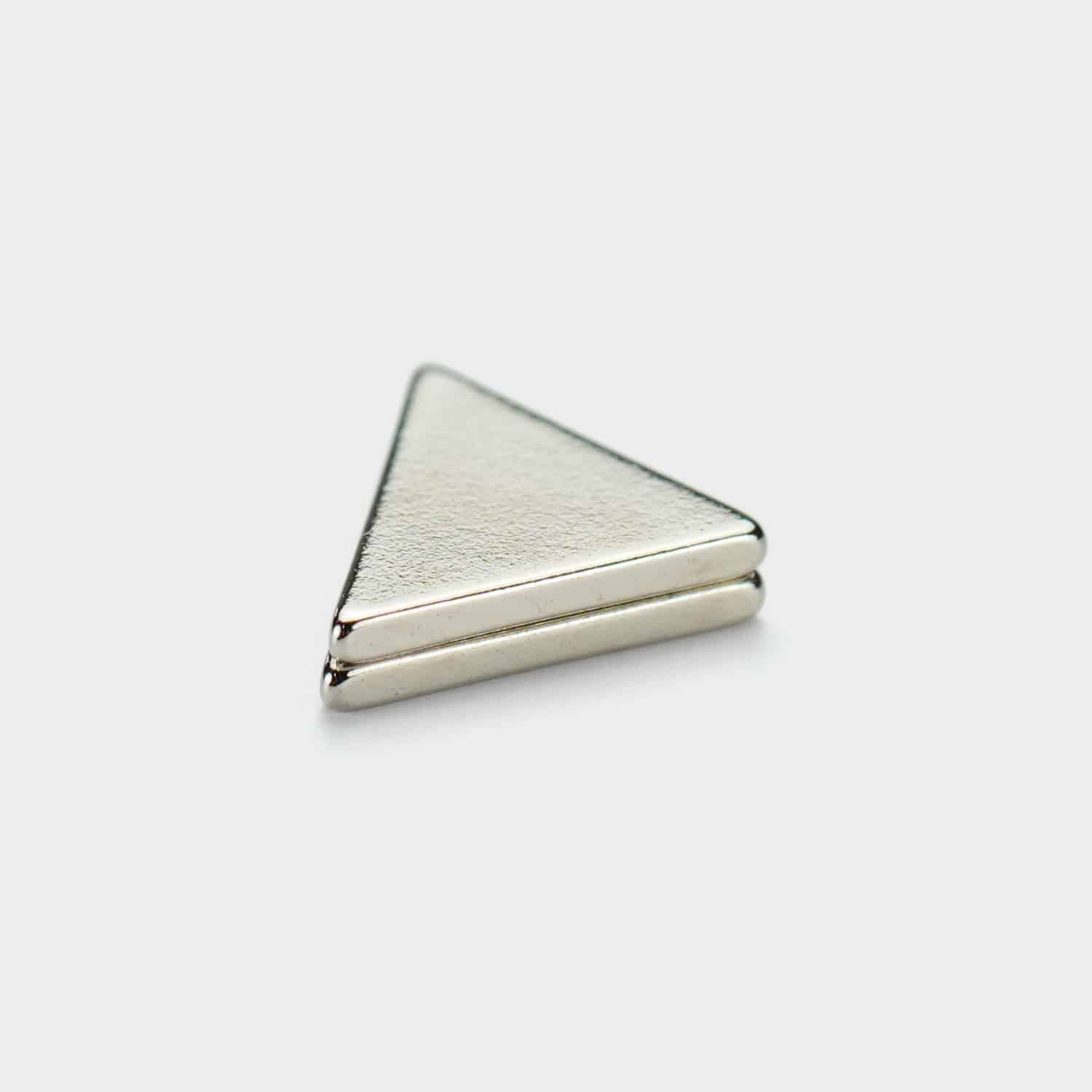
As shown in our product image, these are not rough-cut shards.
They are precision-machined Triangular Prisms featuring smooth, Radiused Corners.
Standard block manufacturing produces square shapes.
We use Wire EDM (Electrical Discharge Machining) or Profile Grinding.
These techniques produce triangular geometries with strict symmetry and zero tooling costs for custom sizes.
We can offer a perfect Equilateral Triangle (all sides equal) for tessellating patterns.
Or a Right-Angle Triangle for corner fitting,
And deliver high-grade N35–N52 magnets tailored to your print.
The “Tip” Challenge
This explains why your product (with rounded corners) is better than a cheap sharp triangle.
1. Tip Fragility & Safety:
Sintered Neodymium is brittle.
A triangle with razor-sharp vertices (<60∘) is extremely prone to structural failure.
The Risk:
– The sharp tips will chip instantly upon impact (the “corner snap” effect).
Our Solution:
– We apply a controlled Corner Radius (R) to all three tips (as seen in the photo).
The Benefit:
– This dramatically increases durability.
– Prevents the magnet from scratching surfaces.
– And ensures a smooth, uniform plating layer without “burnt” or rough edges.
2. Mosaic & Modular Fit:
The Application:
– Triangles are often used to form larger polygons (hexagons) or linear arrays.
The Fit:
– Our Wire EDM process ensures that the side walls are perfectly straight and perpendicular.
– This allows multiple triangles to be tiled together with minimal gaps.
Geometric Definitions: Defining the Shape
Triangles are mathematically diverse.
So please let us know the specific type.
To manufacture this, we classify the shape into three categories:
Equilateral:
– All 3 sides are equal length (60° angles).
– Most common for design.
Isosceles:
– 2 Sides equal, 1 side different.
– Common for wedge fits.
Right Angle:
– One 90∘ corner.
– Common for fitting into the corner of a square housing.
Magnetization Orientation
Axial (Through Thickness): The standard orientation.
– Configuration: The triangular face is North, the opposite face is South.
– Use: Stacking, holding, or sticking to a steel wall.
Linear Halbach Array:
– Configuration: The magnetization vector is parallel to one of the sides.
– Use: Specialized motor or particle physics applications.
Surface Coatings
Nickel (Ni-Cu-Ni):
– As shown.
– The rounded corners allow the Nickel to flow smoothly around the tips.
– This creates a continuous corrosion barrier.
Gold (Au):
– Popular for triangular magnets used in jewelry or executive desk toys.
Epoxy:
– For industrial sensors.
Applications
Modular Connectors: Self-aligning magnetic connectors that only lock in 3 specific orientations.
Sensor Housings: Fitting a magnet into a V-shaped groove or corner.
Art & Design: Magnetic puzzles, tangrams, and tessellating wall art.
Textile Fasteners: Triangular shapes resist rotation better than circles when sewn into fabric pockets.
Ordering Guide: What We Need
To quote a triangle, “Size” is not enough.
Please specify:
1). Style: Equilateral, Isosceles, or Right Angle?
2). Dimensions: Length of the Sides (e.g., “10mm Equilateral”) and Thickness.
3). Corner Style: “Sharp” or “Radiused” (as shown)?
4). Quantity: (Wire EDM production takes longer than slicing, so lead times apply).
Reviews
There are no reviews yet.