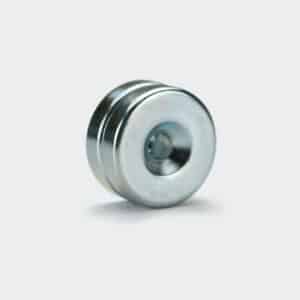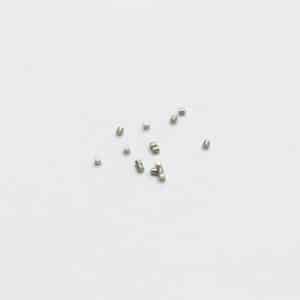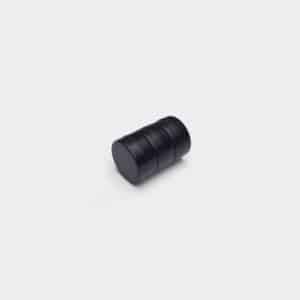


We supply small Stadium-Shaped Neodymium Magnets with a central through-hole.
As shown in our product image, these micro-magnets feature a “Race-Track” or “Obround” profile.
Just 1.0 mm (Width) × 2.0 mm (Length).
Unlike standard round micro-rings, this elongated geometry is made to fit into non-circular slots.
They can provide both magnetic retention and mechanical anti-rotation.
Ideal for micro-robotics, medical catheter guidance.
And precision horology (watchmaking).
These magnets act as “Magnetic Beads”.
You can thread them onto a fine wire or pinned onto a micro-shaft.
Why the “Stadium” Shape?
Explain why a customer would choose this over a simple round ring.
1. Anti-Rotation (The Key Feature):
The Problem:
– A round micro-ring on a pin can spin freely.
The Solution:
– The Stadium shape has flat sides.
– When placed into a matching milled pocket or slot, it physically cannot rotate.
The Benefit:
– This is critical for sensor alignment.
– It ensures the magnetic field always faces the correct direction relative to the Hall Effect sensor.
2. Maximizing Volume in Narrow Spaces:
The Constraint:
– If you only have a 1mm wide channel, the largest round magnet you can use is ∅1mm.
The Solution:
– By using a 1×2 mm stadium shape, you utilize the available length of the channel.
The Benefit:
– You effectively double the magnetic volume (and holding force) compared to a round magnet.
– And you don’t exceed the 1mm width constraint.
Manufacturing Method: Wire EDM
You must explain how you achieve this shape without breaking it.
Precision Wire Cutting:
Drilling a hole in a 1mm wide magnet usually shatters it.
Our Process:
– We use Wire EDM (Electrical Discharge Machining) for these magnets.
– Cut the outer profile and the inner hole simultaneously from a solid block.
The Result:
Stress-free cutting with perfect concentricity and zero micro-cracks.
Tolerances:
– We hold tight tolerances of ±0.02 mm.
– This is essential for micro-assembly interference fits.
Magnetization Orientation
Axial (Through Thickness):
– The standard.
– The flat face with the hole is the pole.
– Used for sticking to surfaces.
Through Length (Longitudinal):
– The rounded ends are the poles.
– Used for “bead-on-a-string” sensor applications.
Note:
Please verify the required direction carefully, as it cannot be changed after production.
Surface Coatings
Nickel (Ni-Cu-Ni):
– As shown.
– Standard protection.
Parylene:
– Strongly Recommended.
– For magnets this small, Parylene (vapor deposition) provides a thinner, more uniform coating.
– It won’t clog the tiny central hole.
Gold (Au):
– For electrical conductivity or biocompatibility.
Handling & Assembly (Micro-Part Warning)
Vacuum Tweezers:
– We recommend using vacuum suction pens to handle these parts.
Non-Magnetic Tools:
– Do not use steel tweezers.
– The magnet will jump to the tool.
– May be impossible to position correctly.
Applications
Medical: Catheter tip guidance markers (Parylene coated).
Consumer Electronics: Micro-actuators in camera lenses.
Jewelry: “Invisible” magnetic clasps threaded onto a chain.
Instrumentation: Galvanometer movements.
Ordering Guide: What We Need
To quote this micro-part, please specify:
1). Dimensions: Length x Width x Thickness (2×1×1 mm).
2). Hole Size: Diameter.
3). Coating: Parylene (Medical) or Nickel (Standard)?
4). Quantity: (Due to setup time for Wire EDM, typical MOQ is 1,000+ pieces).