

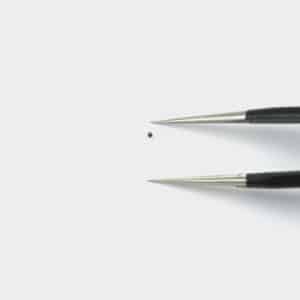
Diameters down to 0.2mm, High Temperature (180°C)
We supply micro UH (Ultra-High) Grade Heat Resistant Neodymium Magnets.
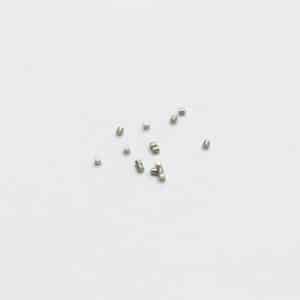
And offer cylinders and discs with diameters as small as 0.20mm.
In the world of micro-engineering, size is usually the only focus.
But heat resistance is equally critical for medical actuators, fiber optic isolators, and high-speed micro-rotors.
Standard micro-magnets (N50/N52) will lose performance rapidly if the device heats up.
Our UH Micro-Series can maintain flux stability up to 180°C (356°F).
Ensure your microscopic device works reliably even under thermal stress.
Why “UH” Grade for Micro-Parts?
Why choose a high-temp grade for a tiny magnet?
It comes down to physics.
1. The “Pc Value” Trap (Self-Demagnetization):
The Physics:
A magnet’s ability to hold its charge depends on its shape.
A tiny magnet (like a 0.2mm dot) has a very low “Permeance Coefficient” (Pc).
It is naturally fighting against its own internal fields.
The Risk:
Because the Pc value is low, a tiny magnet is already close to demagnetizing.
If you add even moderate heat (60-80°C), a standard N52 micro-magnet will fail.
The Solution:
We use UH Grade (Ultra High Coercivity) not just for 180°C environments.
But also to provide the extra “magnetic stiffness” required to keep such a tiny volume stable.
2. Sterilization Survival:
The Application:
Medical catheters or endoscopic tools.
The Requirement:
These devices often undergo Autoclave sterilization (high heat).
Standard micro-magnets would fail.
Our UH grade survives the heat cycle.
3. High-Speed Friction:
The Application:
Micro-motor rotors (0.5mm – 1mm).
The Risk:
At 50,000+ RPM, eddy currents and friction generate localized heat spikes.
UH grade prevents the rotor from losing torque during operation.
Coating Technology (Critical):
The Problem:
Standard Nickel plating is ~15-20 microns thick.
On a 200-micron magnet, the coating would be 20% of the volume!
Our Solution:
We recommend Parylene C (1-3 microns).
Or, Sputtered Nickel (Ultra-thin).
This protects the magnet without altering the precision dimensions.
“Visible Dust”
Please warn your assembly team: These do not look like magnets. They look like dust.
Static vs. Magnetic: At 0.2mm, static electricity and surface tension are often stronger than the magnetic force. The magnets may stick to tweezers due to static, not magnetism.
Tools: Do not use steel tweezers. Use Vacuum Pick-up Tools or non-magnetic fine-point tweezers.
Containment: Open packaging in a cleanroom environment or over a white tray. If you drop a 0.2mm magnet on a carpet, it is gone forever.
Ideal Applications
Fiber Optics: Micro-Isolators and Circulators (Faraday rotators).
Micro-Motors: Stepper motors for watch movements and camera autofocus modules.
Medical Devices: Guide-wire tips and implantable sensors.
MEMS: Micro-Electro-Mechanical Systems actuation.
Ordering Guide: The Micro-Spec
To quote this effectively, we need precise details:
1). Dimensions: Diameter x Length (in microns or mm).
2). Tolerance: “Standard (±0.02mm) or Swiss Precision (±0.005mm)?”
3). Coating: “Is Parylene (thin) required, or is standard Nickel okay?”
4). Quantity: Due to the complexity of micro-slicing, Minimum Order Quantities apply.