

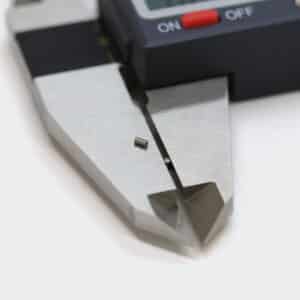
Diameter Ø 1.0mm, Extreme Temp (550°C), Superior Stability
We specialize in the precision grinding of Miniature AlNiCo (Aluminum-Nickel-Cobalt) Cylinders.
They come with diameters as small as 1.0mm.
While Neodymium is the king of raw magnet pull force, AlNiCo is the king of Stability.
These micro-rods are suitable for sensitive instrumentation, aerospace sensors.
And high-heat environments where modern rare-earth magnets would fail or drift.
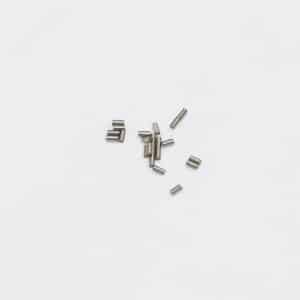
As shown in the product photo, these magnets feature a natural, uncoated metallic finish.
AlNiCo’s inherent corrosion resistance eliminates the need for plating.
Why Choose AlNiCo over Neodymium?
If you need raw holding force, buy Neodymium.
If you need precision and reliability, buy AlNiCo.
1. The Temperature Champion (550°C):
The Problem:
– Neodymium magnets permanently lose strength above 80°C (Standard) or 200°C (High-Temp).
The AlNiCo Solution:
– These 1mm rods can operate comfortably at 500°C – 550°C.
– They are the standard choice for sensors inside engines, exhaust systems, or industrial ovens.
2. Flux Stability (Low Temperature Coefficient):
The Physics:
– Magnets get weaker as they get hotter.
The Difference:
– Neodymium loses strength rapidly as it warms up.
– AlNiCo has the lowest Temperature Coefficient of any magnetic material (-0.02%/°C).
The Benefit:
– If you are building a speedometer, a Hall effect sensor, or a guidance gyroscope, you need the magnetic field to remain constant>
– No matter the device is freezing or burning hot.
– AlNiCo delivers that flat stability.
3. Corrosion Resistance:
The Benefit:
– Neodymium magnets rust instantly if not plated.
– But AlNiCo is chemically stable.
– These 1mm rods can be used submerged in oil, fuel, or solvents without degradation.
The “Aspect Ratio”
AlNiCo behaves differently than other magnets. You cannot design it like a disc.
The “Rod” Requirement:
AlNiCo has low Coercivity (Hci).
This means it is easily demagnetized – sometimes even by its own magnetic field if the shape is wrong.
– The Rule: To maintain a strong, stable open-circuit flux, AlNiCo cylinders must be long and thin.
– Recommendation: We strongly recommend a Length-to-Diameter (L/D) Ratio of at least 4:1.
– Example: If your Diameter is 1.0mm, the Length should ideally be 4.0mm or longer.
– Warning: Do not design a 1mm x 1mm AlNiCo “coin.” It will self-demagnetize and become very weak.
Manufacturing Capabilities: Centerless Grinding
Casting tiny magnets is impossible.
We use precision machining.
Process:
– We manufacture these rods using Sintered AlNiCo.
– Or by casting larger blocks and then using Centerless Grinding to achieve the 1.0mm diameter.
Tolerance:
– The grinding process allows us to hold strict diameter tolerances of ±0.01mm (ISO h6).
– This makes these rods perfect for press-fitting into machined holes or bearing assemblies.
Finish:
– Standard finish is “Ground / Cut” (Matte Grey metallic).
Ideal Applications
Automotive Sensors: Speedometers and Tachometers requiring consistent output.
Aerospace: Gyroscopes and guidance instruments exposed to stratospheric temp changes.
Guitar Pickups: Micro-rods for specialized string instrument pickups.
Reed Switches: Activating glass reed switches in security alarms (where the long rod shape fits parallel to the switch).
Ordering Guide: Precision Rods
To quote these custom rods, please specify:
1). Dimensions: Diameter x Length.
2). Grade:
– AlNiCo 5: (Standard, strongest flux, requires 4:1 length ratio).
– AlNiCo 8: (Higher coercivity, allows for shorter lengths, but slightly lower flux).
3). End Finish: “Cut” (sharp edges) or “Tumbled” (slightly rounded edges)?
4). Tolerance: Do you need standard (±0.05mm) or Precision Bearing fit (±0.01mm)?