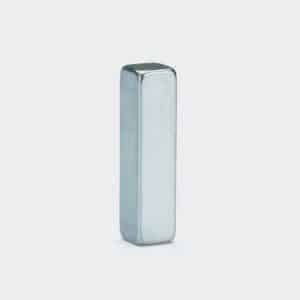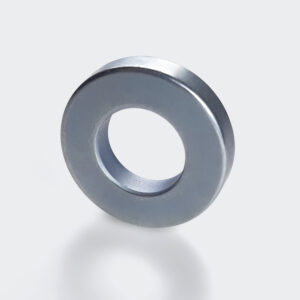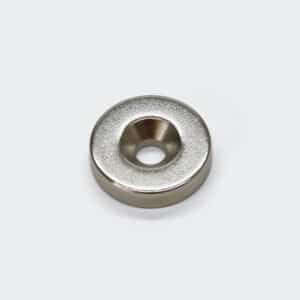


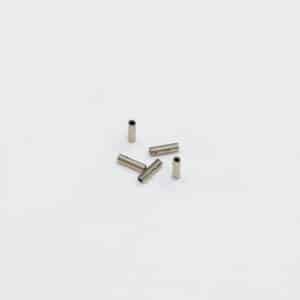
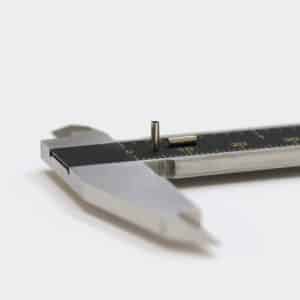
OD down to 1mm, ID down to 0.2mm, N52 High-Density Energy
We offer precision Hollow Micro-Cylinders Neodymium Magnets.
Many suppliers struggle with holes smaller than 1mm.
We can produce Neodymium tubes with Inner Diameters (ID) as microscopic as 0.20mm.
These components are critical for small or compact assemblies.
Their magnet must slide over a fiber optic strand, a micro-shaft, or a medical guide wire.
The magnet’s volume is reduced by the central bore.
So, we use Grade N52—the strongest commercially available magnetic material.
It maximizes flux density and ensure functional holding force despite the minimal mass.
Why N52 Micro-Tubes?
These are not standard ring magnets. They are precision functional components.
1. The “Fiber-Optic” Fit (0.2mm ID):
The Application:
Optical Isolators and Collimators.
The Logic:
In photonics, light must pass through the center of the magnetic field (Faraday Rotation).
Our 0.2mm bore capability allows single-mode fibers to pass directly through the magnet axis with minimal clearance.
It maximizes the field efficiency around the fiber.
2. Concentricity is King:
The Problem:
If the hole is slightly off-center (“eccentric”), a high-speed micro-motor will vibrate, or a laser beam will be misaligned.
Our Precision:
We guarantee high Concentricity (T.I.R.).
The inner bore is perfectly centered relative to the outer diameter.
Ensure smooth rotation for micro-rotors and precise alignment for sensor stacks.
3. Aspect Ratio Flexibility (2mm – 20mm Length):
The Capability:
We can slice short “washers” (2mm) or deep “pipes” (20mm).
Engineering Note:
Deep tubes (e.g., 20mm long) provide a highly uniform internal magnetic field.
Ideal for linear particle acceleration or guidance channels.
Wall Thickness & Plating
Physics sets the limits on how “hollow” we can make these.
1. The “Hoop Strength” Warning:
For a magnet with an OD of 1.0mm, the structural integrity depends on the Wall Thickness [(OD – ID) / 2].
The Risk:
A 1.0mm OD magnet with a 0.8mm ID has a wall thickness of only 0.1mm.
This is thinner than paper.
It is extremely fragile and has almost zero “hoop strength.”
Our Advice:
We recommend maintaining a wall thickness of at least 0.3mm for safe handling.
If you need thinner walls, the magnet must be glued into a support sleeve immediately.
2. Plating the Micro-Bore:
The Challenge:
Getting Nickel plating to flow inside a 20mm long tube with a 0.2mm hole is physically difficult.
It’s because of the “Faraday Cage” effect in plating baths.
The Solution:
For high-aspect-ratio tubes (Long + Narrow ID), we may recommend Parylene coating.
Or leaving the ID unplated if the environment allows.
Ideal Applications
Medical Devices: Guide-wire steering magnets for catheters.
Photonics: Faraday rotators and isolators requiring light transmission.
Micro-Robotics: Actuators sliding on guide pins.
Coreless Motors: Rotors for miniature vibration motors.
Ordering Guide: Precision Dimensions
To manufacture this part, we need precise numbers.
Please provide:
1). Dimensions: OD x ID x Length.
2). Magnetization Direction:
– Axial: Most common for sensing and optical applications.
– Diametric: Used for rotational motor applications.
3). Shaft Fit: “What is the diameter of the wire/shaft going through the hole?” (We will size the ID to ensure a clear slip-fit).
4). Quantity: (Due to EDM setup time, micro-tubes are typically produced in batches of 500+).