
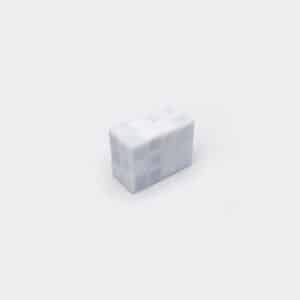
Seamless PTFE Encapsulation, Aggressive Mixing, Chemically Inert
We manufacture Custom Magnetic Stirring Cubes encapsulated in medical-grade PTFE (Polytetrafluoroethylene).
Standard cylindrical stir bars are designed for gentle mixing in round beakers.
The Cube Geometry is more suitable for aggressive agitation.
The sharp corners create significant hydraulic shear.
This feature makes these magnets ideal for mixing viscous resins, slurries, or difficult-to-dissolve powders.
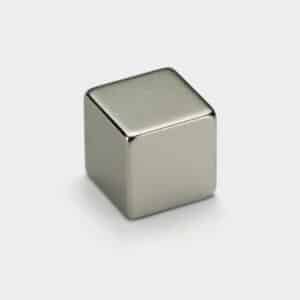
As shown in the product photo, our cubes feature a Thick, Seamless PTFE Shell.
This ensures the Neodymium core is completely isolated from the liquid.
Prevents contamination even when submerged in harsh acids or solvents.
Why a Cube?
Shape determines the flow pattern.
Choose a cube for specific mixing challenges.
1. High-Shear Mixing (Viscosity Handler):
The Physics:
A smooth cylinder allows liquid to flow over it easily.
A cube “fights” the liquid.
The Benefit:
The flat faces and corners push liquid outward violently.
This is perfect for high-viscosity fluids (like oils, gels, or epoxies).
In such cases, a standard stir bar would just spin in place without moving the bulk of the liquid.
2. Square Vessel Optimization:
The Problem:
Standard stir bars work best in round flasks.
In a square tank or vat, they leave “dead zones” in the corners.
The Solution:
A tumbling cube creates a chaotic flow pattern.
And it reaches into the corners of square containers more effectively than a spinning rod.
3. “Scraping” Action:
The Function:
The flat bottom of the cube provides more surface contact than a round pivot point.
This helps scrape precipitates or solids off the bottom of the vessel.
Seamless PTFE
The coating is the only thing standing between your sample and a corroded magnet.
1. Thick Encapsulation (Not a Spray):
Our Process:
We do not simply spray paint the magnet.
We use Isostatic Molding or Machining to encase the magnet in a solid block of Virgin PTFE.
The Thickness:
The coating is typically 0.5mm – 1.0mm thick.
This provides a robust buffer against wear and tear.
Even if the cube drags on the bottom of a glass beaker for months, it will not wear through to the metal.
2. Chemical Inertness:
The Spec:
PTFE is chemically inert to almost all known chemicals (Acids, Bases, Solvents).
It is Hydrophobic and non-stick, making it easy to clean and sterilize (Autoclavable).
Thermal Core Selection: Neo vs. SmCo
PTFE survives heat.
But does the magnet inside?
1. Standard Neodymium Core (Up to 80°C):
For general mixing at room temperature.
Strongest coupling force.
2. Samarium Cobalt (SmCo) Core (Up to 250°C):
The Expert Advice:
PTFE can withstand 260°C.
However, a standard Neodymium magnet dies at 80°C.
The Solution:
If you are performing Heated Stirring (hot plates or oil baths >100°C), you must request a SmCo core.
This ensures the magnet retains its strength even when the PTFE shell is hot.
Ideal Applications
Chemical Synthesis: Mixing aggressive acids (H2SO4, HF) where metal contact is forbidden.
Biotech / Pharma: Cell culture stirring (PTFE is biocompatible/USP Class VI compliant).
Industrial Processing: Mixing paints, resins, or 3D printing slurs in square vats.
Electroplating: Agitating plating baths.
Ordering Guide: Custom Specs
To manufacture these custom stirrers, please specify:
1). Dimensions: Side Length (e.g., 10mm, 25.4mm, 50mm).
2). Core Material:
– Neodymium: Stronger, for cold/viscous mixing.
– SmCo: Required for high-temp reactions (>80°C).
3). Vessel Type: “Are you using glass beakers or large steel tanks?” (Helps us size the magnet strength).
4). Quantity: We can machine single custom prototypes or mold thousands.