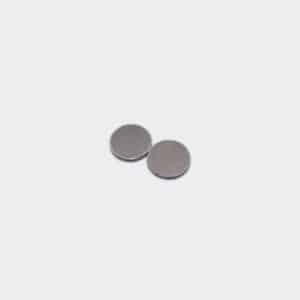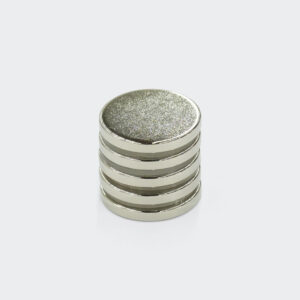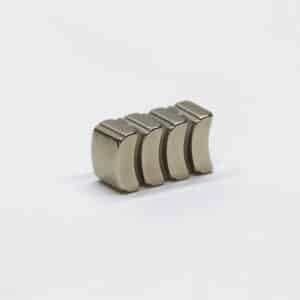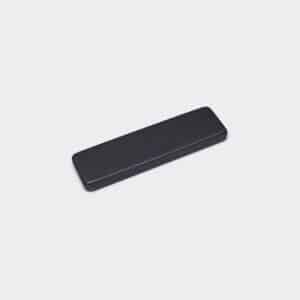

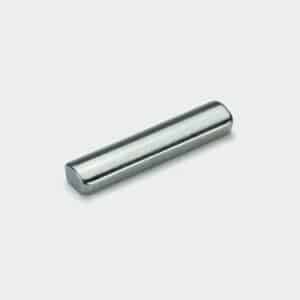
We supply rectangular Neodymium plates with chamfered (clipped) corners.
The four 90° corners are cut at a specific angle, typically 45°.
This creates an 8-sided profile that fits inside circular housings.
And also retain the magnetic advantages of a rectangular plate.
The chamfered corners allow the magnet to clear round tubes, housing bores, or curved stators without interference.
Meanwhile, they maximize usable magnetic material in the available space.
Common applications include voice coil motors, sensor housings.
And magnetic assemblies where you need rectangular field geometry inside a circular constraint.
The Geometry: Why the “Sloped” Sides?
Designed for High-Speed Retention:
The unique “Slope-Shaped” side walls serve a critical mechanical function.
Mechanical Locking:
– In high-speed brushless motors, relying on adhesive can be risky.
– The tapered sides allow this magnet to sit inside a matching “dovetail” slot or under a retaining lip in the rotor.
Air Gap Optimization:
– The curved top surface (Radius) is ground to match the curvature of the stator.
– And minimize the air gap and maximizing magnetic flux efficiency.
Geometric Definitions
Since the shape is complex, please define the dimensions clearly.
To manufacture this accurately, we control four key geometric features:
– The Base: Completely flat for seating against the rotor hub.
– The Radius (R): The curvature of the top surface (Bread Loaf profile).
– The Taper Angle: The angle of the sloped side walls.
– Symmetry: Ensuring the peak of the curve is perfectly centered over the base.
Magnetization Directions
Parallel / Diametric:
– The magnetic field runs perpendicular to the flat bottom.
– Most common for surface-mounted motor magnets.
Radial (Approximated):
The field lines point towards the center of the radius.
Surface Coatings
For motor magnets like this, coating choice affects the glue bond.
Ni-Cu-Ni (Nickel):
– As shown in photo.
– Standard protection.
Phosphated / Passivated:
– Highly recommended if you are gluing the magnet into a slot.
– The rougher, chemical surface bonds better with epoxy than smooth Nickel.
Epoxy:
– For marine or hermetically sealed motors.
Applications
High-Speed Rotors:
– Traction motors, drone motors
– And turbines where centrifugal force is a concern.
Linear Actuators:
– The tapered shape allows for precise alignment in the track.
Magnetic Bearings:
– Specialized wedge shapes for non-contact support.
Ordering Guide: The Critical Dimensions
To quote this complex shape, “Length x Width x Height” is not enough.
We need a drawing that specifies:
1). Base Width (Wbase): The width of the flat bottom.
2). Top Width (Wtop): (If the curve is flattened) or the effective width at the top.
3). Center Thickness (Tcenter): Height at the peak of the curve.
4). Edge Thickness (Tedge): Height at the lowest point of the side wall.
5). Radius (R): The top curvature.
6). Length (L): Total length.
(Note: Providing a CAD file (STEP/IGES) is highly recommended for this shape).