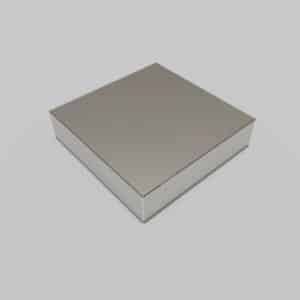


We supply custom rectangular Neodymium plates with chamfered corners.
The four 90° corners are cut off at an angle (typically 45°), creating an 8-sided profile.
This shape solves a common design problem:
– Fitting a rectangular magnet into a circular housing.
– The chamfered corners allow the plate to clear a round tube, housing bore.
– Or, curved stator while retaining most of the rectangular magnetic area.
Compared to a round disc of the same diameter, the chamfered rectangle contains more magnetic material and delivers higher flux density.
Useful in voice coil actuators, sensor housings.
And magnetic assemblies where space is limited but magnetic strength is critical.
The “Corner Cut” Logic: Why use this shape?
Optimizing the “Fit”:
Why cut the corners off?
Tube Integration:
– If you place a standard square magnet inside a round tube, the sharp corners hit the tube walls first, wasting space.
– By chamfering the corners, you can use a wider magnet.
– This significantly increases the magnetic flux compared to a standard block.
Weight Reduction:
– For aerospace and high-speed moving parts, clipping the “dead weight” corners reduces mass.
– And won’t significantly impact the central magnetic field.
Clearance:
– Avoiding internal ribs, screws, or standoffs inside an electronics housing.
Geometry & Terminology: Defining the Cut
You must distinguish between a safety chamfer and this geometric feature.
To manufacture this correctly, we distinguish between two types of chamfers:
The “Corner Chamfer” (C):
– The main feature in the photo.
– This is the large diagonal cut on the four corners.
– You must specify the length of this cut (e.g., C2mm or 3mm x 45°).
The “Edge Chamfer” (R):
– The microscopic smoothing along the sharp edges of the face.
– Prevent plating chips (standard on all our magnets).
Production Method
Wire EDM / Slicing:
– Unlike molded parts, these shapes are typically sliced from larger blocks using precision wire cutting.
– This allows for zero tooling costs for custom chamfer sizes.
Grinding:
– For high-volume orders, we use profile grinding wheels.
– Ensure identical consistency across thousands of pieces.
Magnetization Orientation
Axial (Through Thickness):
– The standard.
– The large octagonal flat face is the North/South pole.
Transverse:
– Magnetized across the width.
Surface Coatings
Ni-Cu-Ni (Nickel):
– As shown in the photo.
– The chamfered corners take plating very well.
– Give you a smooth, high-luster finish that is more corrosion-resistant than sharp-cornered blocks.
Zinc (Zn):
– Cost-effective alternative.
Epoxy:
– For outdoor or glued applications.
Applications
Tubular Sensors: Fitting a flat sensor magnet inside a round probe housing.
Motor Magnets: Fitting flat magnets onto a rotor or inside a stator shell where space is curved.
Medical Devices: Handheld tools where sharp internal corners must be avoided for ergonomic housing design.
RFID Tags: Heavy-duty tags where corners are clipped to prevent tearing the casing.
Ordering Guide: Critical Dimensions
To quote this item, a simple L x W x H is not enough.
We need:
1). Length (L) & Width (W): The overall outer dimensions.
2). Thickness (T): The height.
3). Chamfer Size (C): How much material is cut off? (e.g., “3mm chamfer”).
4). Angle: Is it a standard 45° cut?
Tip:
Sending a 2D sketch is the safest way to ensure the chamfer size is clear to understand.