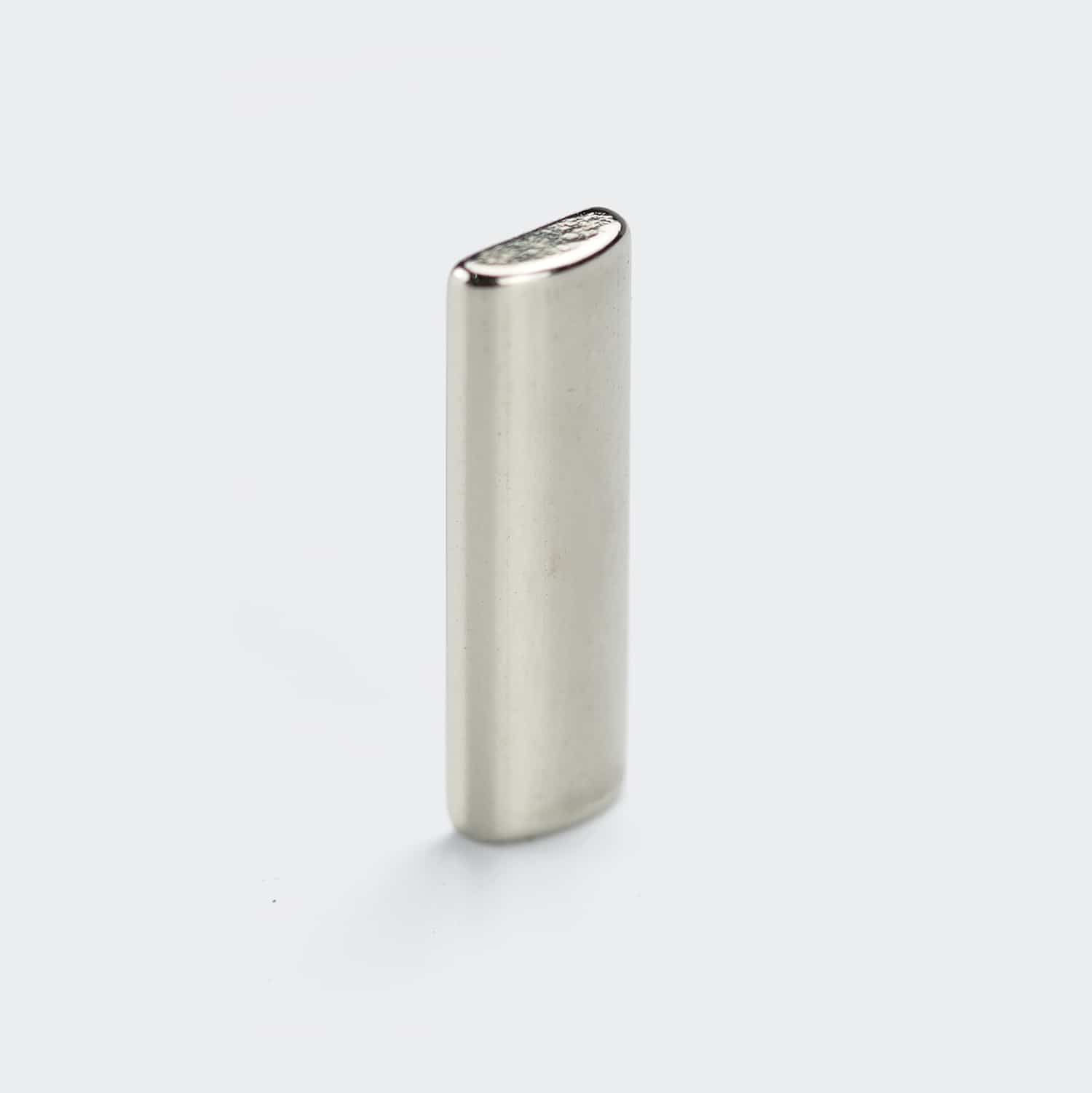
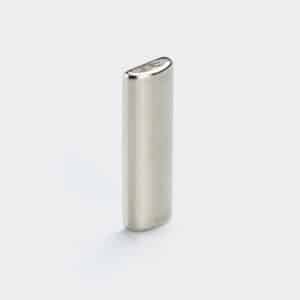
We supply customized Neodymium magnets with curved top surfaces.
They are common for linear actuators, motors, and sensor housings.
The curved profile maintains a consistent air gap between the magnet and a cylindrical rotor or tube wall.
This optimizes field uniformity in rotary and linear motion applications.
We manufacture two profiles:
Half-round (D-shape): Semi-cylindrical cross-section with a flat base and curved top – standard for rotor applications
Bread loaf: Rectangular base with a radiused top – used where a wider footprint or specific mounting geometry is required
Both are custom-ground to your CAD specifications.
Provide your base dimensions, radius, and magnetization direction.
Shape Classifications: What Profile Do You Need?
Since “Half Round” is vague, please clearly define the cross-section.
To ensure we manufacture the correct geometry, we categorize these into two types:
The Semi-Cylinder (D-Shape):
– Geometry: Imagine a round rod sliced perfectly down the center.
– Profile: A flat bottom and a full 180° arc on top.
– Application: clamping onto flat surfaces, liquid level sensors.
The “Bread Loaf” (Motor Magnet):
– Geometry: A rectangular block where the top face is ground to a specific Radius (R), with flat vertical sides.
– Profile: Looks like a loaf of bread.
– Application: Linear motors, Voice Coil Motors (VCM), and generator arrays.
The Engineering Advantage: “Air Gap” Control
Why do people use this shape?
To reduce motor vibration.
Optimizing Magnetic Performance:
Engineers choose the “Bread Loaf” shape to control the magnetic flux distribution.
Reduced Cogging:
– In motor applications, the sharp corners of a square magnet cause “torque ripple” (vibration).
– The curved top of our magnets softens the magnetic transition, resulting in smoother motor operation.
Tight Fit:
– The radius allows the magnet to sit closer to the coil or rotor.
– It minimizes the air gap and maximizing efficiency.
Magnetization Directions
For this shape, orientation is everything.
Diametric / Parallel:
– The magnetic lines run straight up and down (perpendicular to the flat bottom).
– Most Common for standard holding or basic sensors.
Radial (Approximated):
– The magnetic lines converge towards the center of the radius.
Note:
True radial magnetization is difficult.
We often approximate this using Halbach arrays or specialized coil fixtures.
Please consult us.
Production & Finishes
Process:
– These shapes are not molded.
– They are sliced from blocks and then Profile Ground using diamond wheels.
– This ensures the curve is smooth and consistent.
Chamfers:
– The bottom sharp edges (where the flat base meets the side) are chamfered to prevent chipping during installation.
Coatings:
– Nickel (Ni-Cu-Ni): Standard.
– Passivated / Phosphated: Recommended if you are gluing this magnet into a motor assembly (better adhesion).
– Epoxy: For high-humidity environments.
Applications
Linear Motors: The track magnets used in high-speed pick-and-place machines.
Voice Coil Actuators (VCM): Used in hard drive heads and speaker systems.
Tube Sensors: Magnets that must clamp onto the outside of a pipe.
Magnetic Bearings: Non-contact shaft support.
Ordering Guide: The Critical Dimensions
To quote a Half-Round or Bread-Loaf magnet, we need 4 key dimensions:
– Width (W): The flat bottom width.
– Length (L): The total length.
– Center Thickness (Tc): The height at the peak of the curve.
– Radius (R): The curvature of the top.
Tip:
– If you don’t have the Radius, you can give us the Edge Thickness (Te).
– And we can calculate the Radius for you.