
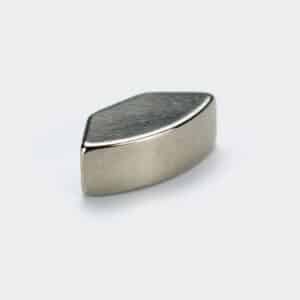
We supply custom circular segment Neodymium magnets (also called chord magnets or D-profile magnets).
It is a disc shape with one or more flat sides created by a straight chord cut.
Standard versions have sharp edges at the intersection of the flat and curved surfaces.
Radiused-edge versions are available.
Their edges are rounded to create a smooth, pebble-like profile.
Radiused edges are used in applications where the magnet slides or reciprocates inside a close-fitting cylindrical tube or housing.
The rounded contours reduce the risk of edge chipping, scratching of the housing wall, and jamming during linear motion.
They are common in:
– Linear actuators, reciprocating pumps, shaker assemblies, pneumatic or hydraulic pistons, magnetic dampers.
– And fluid valve mechanisms where a non-circular magnet is needed to prevent rotation inside a round bore.
Magnetization is typically diametral (across the flat chord face) or axial (through the thickness).
It depends on the application.
Available with standard nickel plating or alternative coatings.
The Engineering Logic: Why this Shape?
Explain the function of the “Cut” and the “Curves”.
1. Fluid & Wire Clearance (The Chord Cut):
– The Problem: If you put a full piston magnet inside a cylinder, it blocks airflow or fluid.
– The Solution: The straight “Chord” cut creates a channel.
– The Benefit: This allows air, oil, or wires to pass alongside the magnet while the curved side maintains tight contact with the tube wall for guidance.
2. Durability (The Radiused Corners):
The Problem:
– A standard segment magnet has two sharp points where the straight line meets the circle.
– These points chip instantly upon impact.
The Solution: Radius these corners (as seen in the photo).
The Benefit:
– This eliminates stress risers.
– And makes the magnet impact-resistant and safe for high-cycle oscillation.
Geometric Definitions: Defining the Segment
Segments are mathematically tricky to produce.
You need to be clear about which dimensions to measure.
To manufacture this, we need specific parameters:
1). Outer Diameter (OD): The diameter of the original circle.
2). Chord Length (W): The length of the straight flat edge.
3). Segment Height (H): The distance from the center of the chord to the peak of the arc (sagitta).
4). Thickness (T): The magnet’s height.
Manufacturing Method: Wire EDM
Process:
– Standard slicing saws cannot create the smooth rounded corners seen in the photo.
– We use Wire EDM (Electrical Discharge Machining) to cut the profile.
– And also the corner radii in a single continuous path.
Precision:
– This allows us to hold the profile tolerance to ±0.05mm.
– And ensures the magnet doesn’t bind inside your housing.
– Higher precision available if needed.
Magnetization Orientation
The orientation defines the sensor signal or holding force.
Axial (Through Thickness):
– The standard.
– The top flat D-shape is North.
– And the bottom is South.
Diametric (Through Diameter):
– Magnetized parallel to the flat face.
Application:
– Used in rotary angle sensors where the magnet rotates above a chip.
Surface Coatings
Nickel (Ni-Cu-Ni):
– As shown.
– The tumbled/radiused edges allow for exceptionally thick and uniform plating.
– It provides superior corrosion resistance compared to sharp-edged magnets.
Epoxy:
– Recommended for magnets used in fluid valves or pumps.
Parylene:
– For medical pistons.
Applications
Haptic Engines: The moving mass inside linear vibration motors (smartphones/game controllers).
Flow Switches: The magnet moves inside a pipe; the cut side lets water pass until flow pressure pushes the magnet to a trigger point.
Rotary Sensors: The “D” shape acts as a visual key for orientation on a shaft.
Shaker Flashlights: The magnet slides back and forth through a coil to generate power.
Ordering Guide: What We Need
To quote this, please provide:
1). Diameter (OD) of the curved side.
2). Thickness.
3). The “Cut” Dimension: You can give us the Chord Length OR the Segment Height.
4). Corner Style: “Sharp” (Standard) or “Radiused/Tumbled” (as shown in photo)?