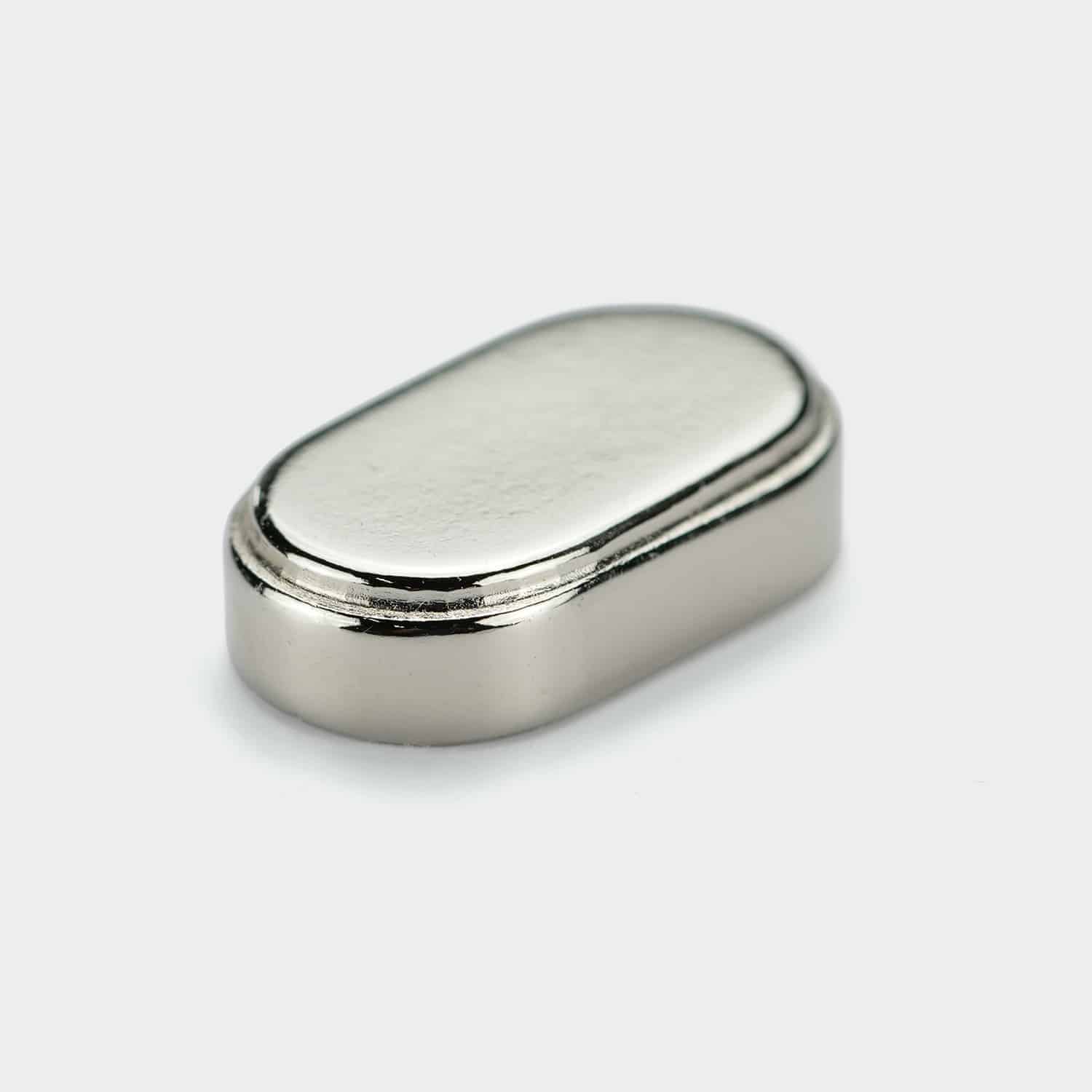

Stepped Geometry, Anti-Rotation, Secure Housing Fit
We offer complex machined Stepped Racetrack (Stadium) Magnets.
They are not a standard off-the-shelf component.
It is a custom-made shape.
And features a “Shoulder” or “Step” profile cut into a rounded rectangular body.
This geometry is designed for High-Security Integration.
Simple block or disc magnets rely solely on adhesive to stay in place.
But the “Stepped” profile allows this magnet to be mechanically seated inside a casing.
The flange (wider base) physically prevents the magnet from being pulled out of the assembly.
Provides a fail-safe hold even if the glue fails.
Why this Complex Shape?
Machining a step is expensive.
You may need it for two critical reasons:
1. Mechanical Retention (The “Pull-Through” Stop):
The Problem:
Strong magnets pull hard.
Over time, a standard magnet glued into a plastic hole can rip the glue apart.
And pull itself out of the product.
The Solution:
The “Step” acts as a physical anchor.
You install this magnet from the inside of the housing.
The wider base rests against the housing wall.
It becomes physically impossible for the magnet to be pulled through the front hole.
2. Anti-Rotation (The “Stadium” Shape):
The Problem:
Round stepped magnets can spin inside their hole.
They will twist wires or misaligning sensors.
The Solution:
The “Racetrack” (Oval/Stadium) shape is non-circular.
It keys perfectly into a matching milled pocket and prevents any rotation.
This is critical for alignment-sensitive closures in luxury handbags or electronic cases.
Manufacturing Capabilities: Wire EDM Precision
You cannot slice this shape; it must be profiled.
Wire EDM Cutting:
The Process:
Use Wire Electrical Discharge Machining (EDM) or Profile Grinding
We can achieve the “Step” and the perfect “Racetrack” curves simultaneously.
The Benefit:
This allows us to hold tight tolerances (±0.03mm) on the step height.
Ensures the magnet sits perfectly flush with your product surface.
The Radius (R-Edge):
Observation:
Notice the smooth, rounded edges in the photo.
The Reason:
A stepped magnet has sharp internal corners that are stress points.
We apply a tumble finish or specific radius.
Make sure the plating (Nickel) adheres smoothly and the magnet doesn’t crack under load.
Ideal Applications
Luxury Handbags: Magnetic snaps that must not twist or pull out of leather/fabric.
Consumer Electronics: Battery door latches where the magnet is installed from the inside.
Molded Plastic Enclosures: Insert-molded magnets where the step locks into the plastic.
3D Printed Prototyping: Press-fit components that need a mechanical stop.
Ordering Guide: The “Profile” Drawing
To quote this magnet, a simple L x W x H is not enough.
We need a 2D drawing defining:
1). Base Dimensions:
Length x Width (of the wider bottom).
2). Top Dimensions:
Length x Width (of the narrower top).
3). Step Height:
– How tall is the bottom flange?
– How tall is the top section?
4). Radius:
– Are the ends fully semi-circular (R = Width/2)?
– Or just rounded corners?