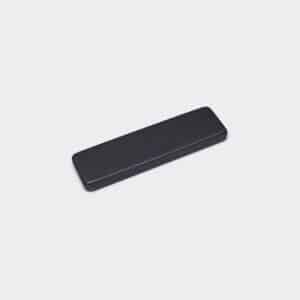


We supply custom Neodymium magnets with a flat trapezoidal profile.
With a wide base tapering to a narrower top face, with a low-profile (thin) cross-section.
This geometry is designed for surface-mounted applications.
The wide base provides greater bonding area when glued to a backplate or track.
The tapered sides enable tight side-by-side packing in circular arrays (such as motor stators).
Or, linear assemblies, minimizing gaps between adjacent magnets.
Common in halbach arrays, sensor arrays.
And applications where surface-mounted magnets need to tessellate efficiently.
Specify your base width, top width, thickness, length, and taper angle.
The Engineering Logic: Why the “Wide Base”?
1. Maximum Glue Surface (Shear Resistance):
In high-acceleration linear motors, shear force can rip a magnet off its track.
The Advantage:
– By maximizing the width of the bottom face (Wmajor), we lower the center of gravity.
– And drastically increase the surface area available for epoxy bonding.
– This makes the magnet exceptionally stable and resistant to detaching.
2. Flux Focusing (Halbach Arrays):
This shape is the classic “Side Magnet” in a Halbach Array.
The Function:
– The wedge shape allows the magnetic field to be “steered”.
– Or, compressed between two rectangular magnets.
– It boosts the holding force on one side while cancelling it on the other.
The Fit:
The angled sides ensure minimal air gaps between the wedge and its neighboring magnets.
Technical Geometry: Defining the “Plate”
Trapezoids are notoriously difficult to quote without a drawing.
You must define the parameters.
To manufacture this part, we control the following dimensions via profile grinding:
– Bottom Width (Wmajor): The widest dimension (the base).
– Top Width (Wminor): The top flat face.
– Thickness (T): The height (usually thin/low profile).
– Taper Angle: The angle of the slope.
Edge Condition:
– Standard chamfer or light radius (as shown in the photo)?
– The purpose is to prevent chipping during assembly.
Magnetization Orientation (Critical!)
For this shape, the direction is almost never “up and down.”
Transverse (Parallel to Face):
– The magnetic field runs from the left slope to the right slope.
– This is essential for Halbach Arrays.
Through Thickness:
– The poles are on the Top and Bottom faces.
– Used for clamping/holding.
Angled (Vector):
– We can produce custom magnetization angles (M) relative to the geometry for specialized flux focusing.
Surface Coatings
Ni-Cu-Ni (Nickel):
– As shown.
– A durable, smooth finish.
Phosphated / Passivated:
– Highly Recommended.
– If you will glue this “Wide Base” shape, a phosphated surface provides higher shear strength with structural epoxies.
– So, we can say it’s more suitable than Nickel plating.
Zinc (Zn):
– Cost-effective for less critical applications.
Applications
Linear Motors: The “track” magnets used in pick-and-place machines and maglev systems.
Halbach Arrays: Used in particle accelerators, free-electron lasers, and high-end loudspeaker assemblies.
Sensor Targets: The dovetail shape acts as a key to ensure the sensor magnet is installed in the correct orientation.
Clamping Wedges: Mechanical hold-downs.
Ordering Guide: What We Need
To quote this item, please provide a drawing or specify:
1). Dimensions: Bottom Width, Top Width, Thickness, Length.
2). Magnetization: This is the most common error. Please specify if the field flows through the Thickness (Up/Down) or the Width (Side-to-Side).
3). Quantity: (Trapezoids are batch-produced).
4). Coating: Nickel (Shiny) or Phosphated (Dark Grey for gluing)?