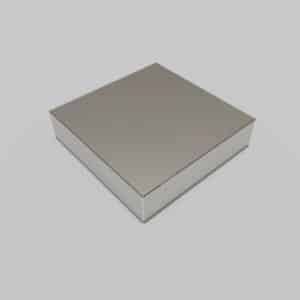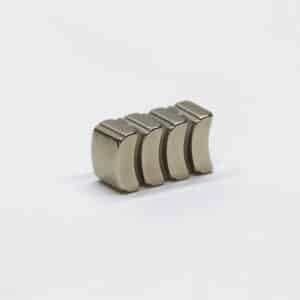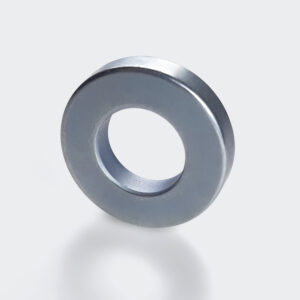
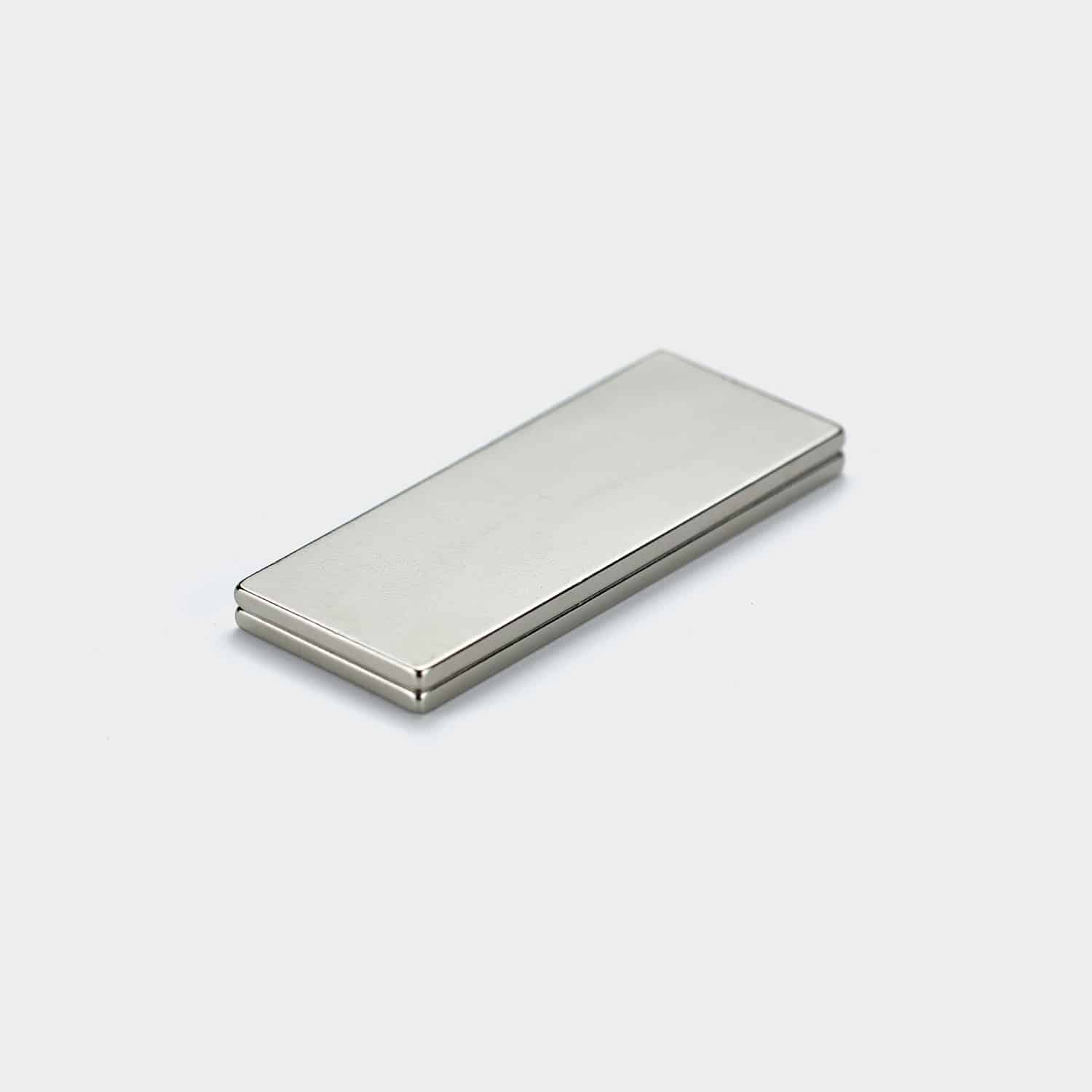
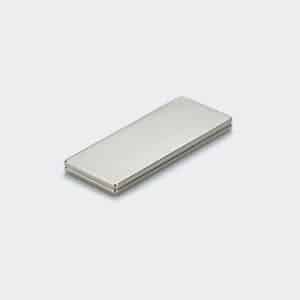
We supply customized Neodymium plate magnets as thin as 0.4mm for low-profile applications.
Commonly used in slimline electronics, smart wallet closures, PCB sensors.
And other designs where space is critical.
Thin sintered magnets typically bow or warp during manufacturing.
We use double-sided grinding to ensure flatness and parallelism across the entire surface.
Critical when magnets must fit tight tolerances or bond flush to substrates.
Available custom-cut to your exact dimensions for lamination or adhesive bonding.
The “Thickness Limit” (Expert Guidance)
How thin can we go?
The minimum achievable thickness depends on the Length x Width surface area (Aspect Ratio).
– Small Plates (e.g., 10x10mm): We can supply down to 0.4mm – 0.5mm.
– Large Plates (e.g., 50x50mm): We recommend a minimum thickness of 1.5mm – 2.0mm to maintain structural integrity.
The Risk:
– As the surface area increases, a very thin magnet becomes extremely fragile.
– Just like a potato chip, and it can be difficult to coat without cracking.
Handling & Brittleness Warning
This section saves you from “Broken on Arrival” claims.
“Zero-Flex” Material:
– Please remember that Sintered Neodymium is a ceramic, not a metal.
– It has zero flexibility.
Installation:
– Do not try to flex, bend, or snap-fit a thin plate magnet.
– It will shatter immediately.
Adhesion:
– We recommend bonding these magnets against a rigid backing (steel or stiff plastic).
– The purpose is to provide structural support.
Separation:
– Never try to pry thin plates apart.
– They must be slid sideways.
Surface Coatings for Laminates
Thin plates are often laminated into paper, fabric, or plastic.
The coating matters.
– Ni-Cu-Ni (Nickel): Standard. Smooth and durable.
– Zinc (Zn): Rougher surface, but better “tooth” for some adhesives.
– Phosphated / Passivated: Recommended if you are molding the magnet directly into rubber or plastic (better chemical bonding).
– Epoxy: Ideal if the plate will be exposed to sweat or humidity (wearables).
Packaging: The “Rigid Board” Method
We understand that shipping thin plates is risky.
So we use a Rigid Support Packing System:
– Vacuum Packing: Immobilizes the magnets to prevent movement.
– Oversized Spacers: Plastic spacers between small stacks to allow for safe separation.
– Timber/Board Support: Stacks are taped to stiff boards to prevent the package from flexing during courier transit, ensuring your magnets arrive flat and intact.
Applications
Smart Packaging: Ultra-thin magnets hidden inside luxury box flaps.
Electronics: Hall effect sensor targets in smartphones and tablets.
Fashion: Closures embedded inside leather wallets or handbag linings.
Identification: Name badge backing plates.
Ordering Guide
To quote accurately, we need to calculate the Brittleness Factor.
Please provide:
1). Dimensions: Length x Width x Thickness.
2). Grade: N35, N42, N52?
3). Quantity: (Thin plates are often produced in larger batches due to the slicing yield).
4). Application: “Will this be glued to a rigid surface?” (This helps us advise on the minimum safe thickness).