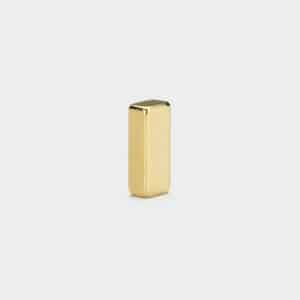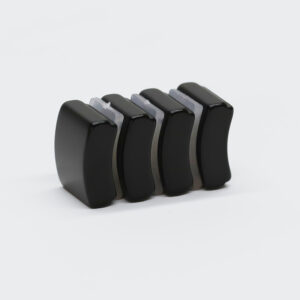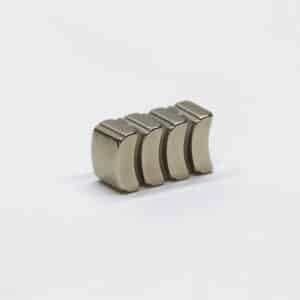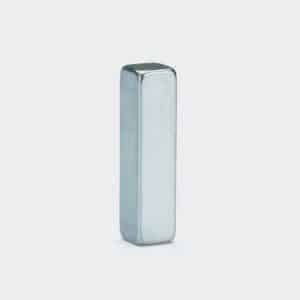

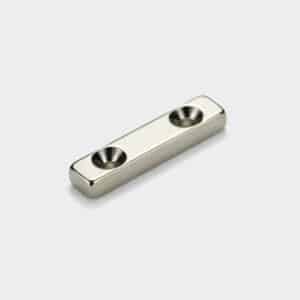
We supply custom rectangular Neodymium magnets with dual countersunk mounting holes.
They have two conical recesses machined into one face.
So they can accommodate flat-head screws for bolt-down installation.
The countersink allows the screw head to sit flush or slightly below the magnet surface.
And maintain a smooth magnetic face without fastener protrusion.
This enables direct contact with the workpiece or target surface while providing mechanical retention.
Common in clamping fixtures, door catches, signage mounting, jigs, tooling plates.
And any other application requiring removable/repositionable mounting to wood, metal, or plastic substrates.
Countersink dimensions typically match ISO 7046 or DIN 963 flat-head screws (e.g., M4, M5, M6).
Hole can be:
– Countersunk on one face only
– Through-hole with countersink on both faces.
Magnetization typically through-thickness (perpendicular to the mounting face).
The Engineering Advantage: Why Two Holes?
This explains why they should choose this over a single-hole magnet.
1. Anti-Rotation (The “Spin” Stopper):
A single screw acts as a pivot point.
Under vibration or torque, a single-hole magnet can loosen and rotate out of alignment.
The Solution:
The second hole acts as an anchor.
The Benefit:
The magnet is geometrically locked in orientation.
It allows for precise alignment of sensors or latches that must stay parallel to the mating surface.
2. Distributed Load:
The Benefit:
Using two screws distributes the clamping force across the length of the brittle ceramic magnet.
This reduces the risk of the magnet cracking around the screw head compared to relying on a single high-stress point.
Installation Advice: Torque & Screw Fit
Preventing Cracks:
– Neodymium is a ceramic material.
– The thin wall inside the countersunk hole is fragile.
Torque Warning:
Do not over-tighten the screws with a power drill. Hand-tightening is recommended.
Screw Head Clearance:
– We ensure the countersink depth is deep enough.
– The purpose is to assure the screw head sits 0.1mm – 0.5mm below the magnet face.
Why?
If the screw head sticks out (protrudes), it will hit the mating steel plate before the magnet does.
And creates an “air gap” that kills 70% of the holding force.
Polarity & Pairing (The “Matched Pair” System)
Crucial for cabinet latches and door closures.
How are you using these?
Magnet-to-Steel: (e.g., Holding a tool to a wall).
Supply:
– We supply all magnets with the same polarity (e.g., North on the countersunk face).
Magnet-to-Magnet: (e.g., A door latch where two magnets meet).
Supply:
– You need Matched Pairs.
Detail:
– Half the order is North-Countersunk.
– The other half is South-Countersunk.
– They attract each other perfectly.
Surface Coatings
Nickel (Ni-Cu-Ni):
– As shown.
– The standard finish.
Zinc (Zn):
– Good for concealing inside cabinetry.
Epoxy:
– Recommended for outdoor gates or marine latches.
– This coating prevents rust around the screw holes.
Applications
Cabinetry & Joinery: Heavy-duty door closures (anti-rotation is key here).
Jigs & Fixtures: Holding steel workpieces on a CNC bed.
Sensor Mounting: Attaching alarm sensors to door frames where tape is not strong enough.
Retail Displays: Mounting heavy signage that needs to be removable.
Ordering Guide: The “Pitch” is Key
To quote this accurately, we need the “Hole Map”:
1). Block Dimensions: Length x Width x Thickness.
2). Hole Size: “Fits M4 Screw” or specific Major/Minor diameters.
3). Hole Pitch: Distance between the centers of the two holes.
4). Polarity: Do you need “Single Polarity” or “Matched Pairs”?