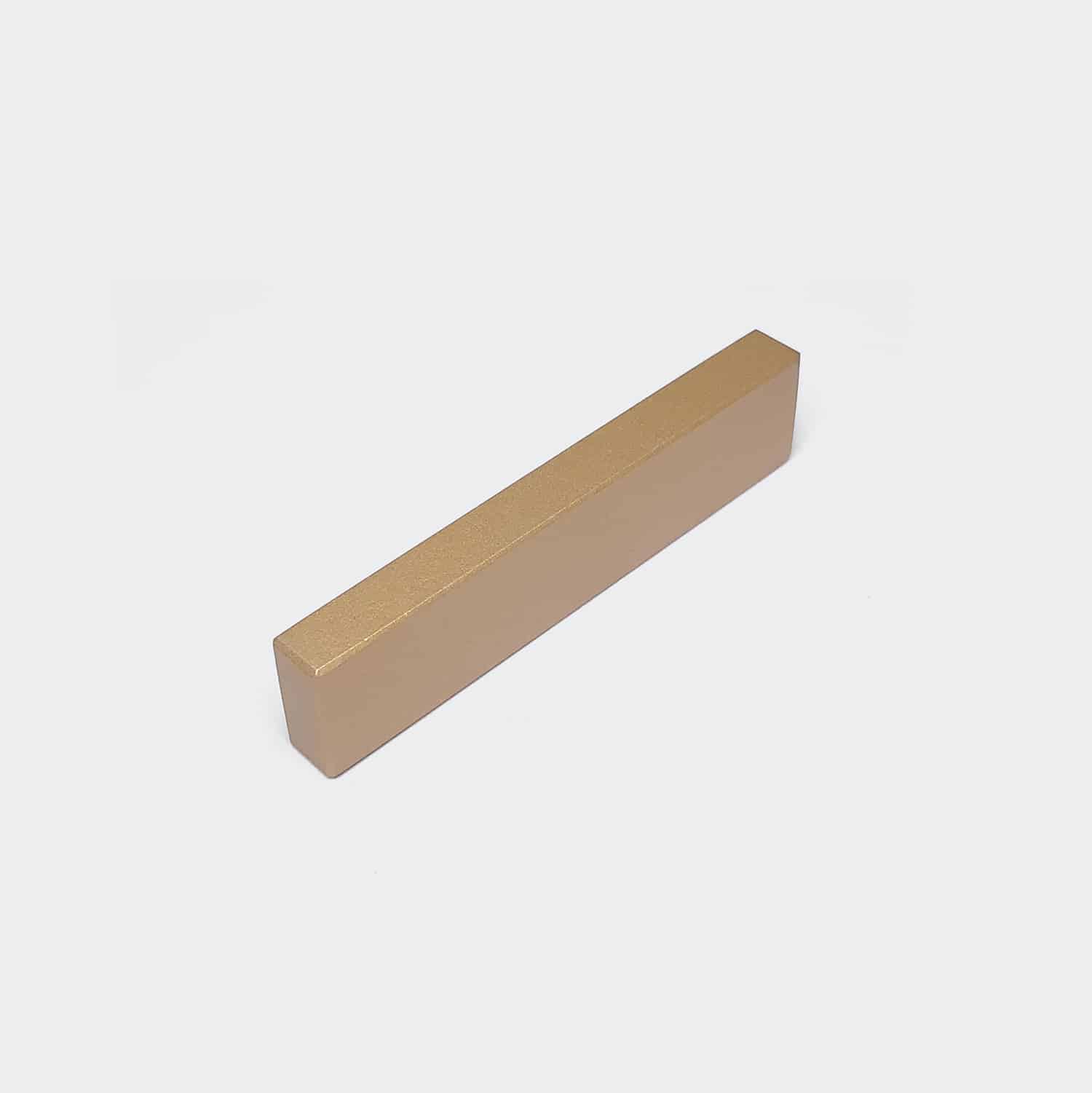

Solid Film Lubricant, Low Coefficient of Friction
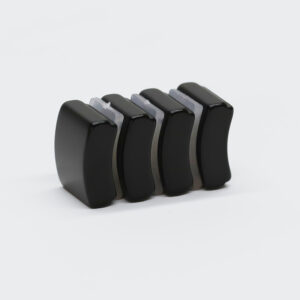
We supply Custom Neodymium Blocks coated with Everlube.
It is a MoS2 / Molybdenum Disulfide based coating.
As seen in the product photo, this finish has a distinct Golden / Metallic Tan appearance.
Unlike standard decorative platings, Everlube is a functional engineering coating designed for dynamic applications.
It combines the corrosion resistance of a high-grade epoxy with the lubricity of Teflon.
This makes it the suitable magnetic component for magnets used in:
– Sliding mechanisms, automotive fluid systems, and aerospace actuators.
– They require low friction and high chemical resistance.
Why Choose Everlube?
Designers specify Everlube when the magnet has to move or survive harsh fluids.
1. Low Friction (The “Sliding” Factor):
The Problem:
Nickel and Epoxy coatings have high surface friction.
If a magnet acts as a plunger in a solenoid or a latch in a sliding door, the coating will gall (wear away) quickly, leading to failure.
The Everlube Solution:
Everlube is a Solid Film Lubricant.
It provides a “slippery” surface (Low Coefficient of Friction).
It allows the magnet to slide repeatedly against steel or plastic housings with minimal wear and no need for wet oils or greases.
2. Chemical & Solvent Resistance:
The Application:
Automotive fuel pumps or hydraulic systems.
The Logic:
Standard coatings can dissolve or blister when exposed to gasoline, jet fuel, or hydraulic oil.
The Everlube Solution:
This aluminized barrier coating is chemically inert to most solvents, fuels, and industrial fluids.
And it makes it ideal for “Under-the-Hood” automotive applications.
3. Salt Spray & Humidity:
The Performance:
When applied over a base layer (usually Ni-Cu-Ni or Phosphating), Everlube offers exceptional salt spray resistance (500+ Hours).
And it rivals the best marine-grade epoxies.
The “Double-Coat” System
Everlube is rarely applied alone.
It is part of a system.
The Barrier Stack:
To achieve maximum durability, we typically apply this as a topcoat:
1). Base Layer: Ni-Cu-Ni (Nickel) or Phosphating. This provides the primary adhesion to the magnet.
2). Top Layer: Everlube 6000 series (or equivalent). This provides the lubrication and chemical seal.
– Total Thickness: 20 – 35 Microns (It is a thick coating; tolerances must be managed).
– Curing: The coating is thermally cured, creating a hard, ceramic-like shell.
Tolerance & Abrasion
1. Dimensional Clearance:
The Warning:
Everlube adds significant thickness (up to 0.035mm per side).
The Advice:
If this block fits into a machined slot, you must undersize the magnet or oversize the slot.
Do not design for a “Line-to-Line” fit, or the coating will shear off during installation.
2. Hardness:
The Benefit:
PTFE (Teflon) is soft and easily scratched.
Meanwhile, Everlube is relatively hard and abrasion-resistant.
However, sharp steel burrs can still scratch it.
Ensure mating surfaces are smooth.
Ideal Applications
Solenoids & Actuators: Plunger magnets that slide inside a cylinder.
Automotive Sensors: Magnets exposed to fuel, oil, or transmission fluid.
Aerospace: Components requiring dry lubrication in vacuum environments (where wet grease outgasses).
Heavy Machinery: Latches in dirty environments where grease would attract dust/grit.
Ordering Guide: Specifying the Coating
To ensure the correct formulation, please specify:
1). Dimensions: Length x Width x Thickness.
2). Base Layer Preference:
– Ni-Cu-Ni Base: Best for max corrosion resistance.
– Phosphate Base: Best for max adhesion (no peeling).
3). Application: “Is this a sliding part?”
– We can adjust the curing process for hardness.
4). Grade: “What is the operating temp?”
– Everlube handles heat well, but the Neodymium grade inside must match.