High-Bond Surface, Electrical Insulator, Marine-Grade Corrosion Resistance
We supply Custom Neodymium Arc (Segment) Magnets encapsulated in a premium Black Epoxy Coating.
Standard Nickel plating is common for general magnets.
But it is often a poor choice for high-performance electric motors.
Our Epoxy coating aims to solve the three biggest challenges in motor design:
– Rotor Adhesion, Eddy Current Losses, and Environmental Corrosion.
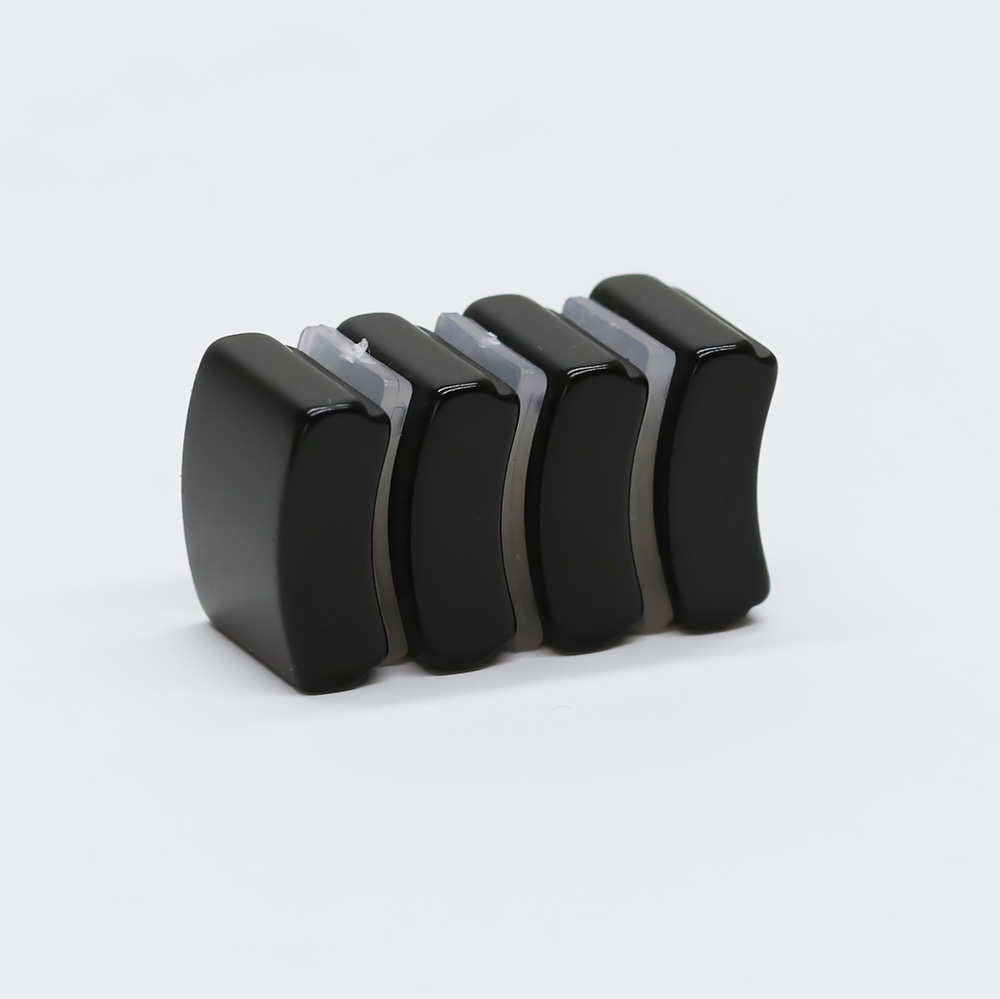
As shown in the product photo, these segments feature a smooth, defect-free black finish with rounded edges.
They are ready for immediate bonding onto steel rotors or stators.
Why Epoxy for Segments?
If you are building a motor, generator, or magnetic coupling, Epoxy offers functional advantages that Nickel cannot match.
1. The “Adhesion” Champion (Rotor Bonding):
The Problem:
Nickel plating is ultra-smooth and chemically passive.
When gluing magnets to a steel rotor spinning at high RPM, Nickel bonds often fail.
And they lead to catastrophic motor damage.
The Epoxy Solution:
Epoxy coating is resin-based.
It possesses high surface energy and a microscopic texture.
It bonds aggressively with industrial structural adhesives (Loctite, Araldite, 3M).
It essentially acts as a primer.
Ensure your magnets stay glued under high centrifugal force.
2. Electrical Insulation (Eddy Current Reduction):
The Physics:
Nickel is a metal; it conducts electricity.
In high-speed motors, the changing magnetic fields induce “Eddy Currents” in the conductive plating.
Generate heat and reducing efficiency.
The Epoxy Solution:
Epoxy is an electrical insulator.
It breaks the circuit on the surface of the magnet.
Prevents coating-based eddy currents.
This helps keep your motor running cooler and more efficiently.
3. Superior Corrosion Barrier:
The Benefit:
Motors often operate in damp or outdoor environments (e.g., pumps, drones, marine outboards).
Epoxy offers 200 – 500 Hours of Salt Spray Resistance.
Far outperforming standard Nickel in high-humidity conditions.
Manufacturing Specs: The “Soft Edge”
Epoxy behaves like paint, not like metal plating.
The geometry must be adapted.
1. Corner Radiusing (Tumbling):
Observation:
Notice in the product photo that the edges of the segments are not sharp.
They are visibly rounded.
The Reason:
Liquid Epoxy pulls away from sharp 90° corners.
Due to surface tension (the “edge-thinning effect”).
Our Standard:
We apply a heavy mechanical tumble to all segments before coating.
This creates a Generous Radius (R).
Ensures the epoxy wraps perfectly around the corners for a hermetic seal.
2. Thickness & Tolerance:
The Spec:
Epoxy is thick (20 – 30 microns).
The Advice:
When calculating your motor’s “Air Gap”, you must account for this extra coating thickness.
Air gap means the space between the magnet and the stator coils.
Do not design a zero-tolerance air gap.
Ideal Applications
Brushless DC (BLDC) Motors: Rotors for drones, power tools, and robotics.
Marine Generators: Magnets exposed to salt air and condensation.
Automotive Pumps: Fluid pumps where the magnet must resist oxidation.
Magnetic Couplings: Torque transfer devices requiring glue stability.
Ordering Guide: Precision Arcs
To manufacture custom segments, we need the “4 Numbers”:
1). Dimensions:
– OD: Outer Diameter.
– ID: Inner Diameter.
– Angle: (e.g., 45°).
– Length: (Height of the arc).
2). Grade: “Is this for a motor?”
– We usually recommend H, SH, or UH grades to resist operating heat.
3). Adhesive: “What glue will you use?”
– We can ensure coating compatibility.
4). Chamfer: “Is a rounded edge acceptable?” (Mandatory for Epoxy).