Ordering custom neodymium magnets involves more than picking a shape.
Suppliers ask about grades, temperature ratings, coatings, and tolerances.
Most buyers don’t know what these terms mean or why they matter.
- This guide explains the essential performance parameters in plain language.
- You’ll learn what each specification means, how to measure it, and when it affects your application.
After reading this, you’ll communicate clearly with suppliers and order magnets that actually work for your needs.
Performance Parameters: What Actually Matters
You need to understand three numbers when ordering neodymium magnets.
Everything else is secondary.
- Grade (BHmax) tells you strength per size.
- Temperature rating tells you if it survives your conditions.
- Pull force tells you if it does the job.
Master these three and you can handle 90% of magnet orders.
Let’s break down each one.
Grade: The Strength Number
Grade appears as N35, N42, N52, or similar on spec sheets.
The number tells you magnetic strength per cubic inch.
N52 stores more magnetic energy than N35 in the same space.
- Think of it like battery capacity.
- A higher number means more power in the same package.
When you should care:
- You’re working in tight spaces. Higher grades let you use smaller magnets.
- You’re trying to reduce weight. A 1-inch N52 disc can replace a 1.5-inch N35 disc.
- You want maximum holding force. Higher grade equals stronger pull for the same size.
When you shouldn’t care:
You have plenty of room. An N35 magnet costs less and works fine if size doesn’t matter.
Your application needs high temperature resistance. N52 magnets lose strength faster when hot.
Real numbers:
- N35 = 35 MGOe energy product
- N42 = 42 MGOe energy product
- N52 = 52 MGOe energy product
A 1-inch diameter N52 disc pulls about 40% harder than an N35 disc of the same size.
Common mistake:
- Ordering N52 because it’s “the strongest” when N35 would work.
- You pay 30-50% more for strength you don’t need.
Temperature Ratings: The Letters After the Grade
You’ll see grades like N42M, N35H, or N38SH.
The letter tells you maximum safe temperature.
No letter (just N42) = 80°C max
M = 100°C max
H = 120°C max
SH = 150°C max
UH = 180°C max
EH = 200°C max
Why this matters:
Heat kills neodymium magnets permanently.
They don’t recover when they cool down.
- A standard N52 magnet left in a hot car (70°C interior) starts losing strength.
- After a summer of heat cycles, it’s noticeably weaker.
Your application temperature isn’t just ambient air:
- Motors generate heat from friction and resistance.
- Sunlight hitting black surfaces adds 20-30°C.
- Enclosures trap heat.
- Friction from moving parts creates hot spots.
How to pick the right rating:
Calculate your worst-case temperature.
- Add 20°C safety margin.
That’s your minimum rating.
Example:
- Your device sits in Arizona sun.
- Ambient hits 45°C.
- Black housing adds 25°C.
- Total = 70°C.
- Add margin = 90°C.
- You need M grade minimum.
The trade-off:
Higher temperature grades cost more.
They also have slightly lower pull force at room temperature.
An N35H pulls about 5-10% less than a standard N35 at 20°C.
But the N35H still works at 120°C while the standard N35 is damaged.
Pull Force: The Number Everyone Wants
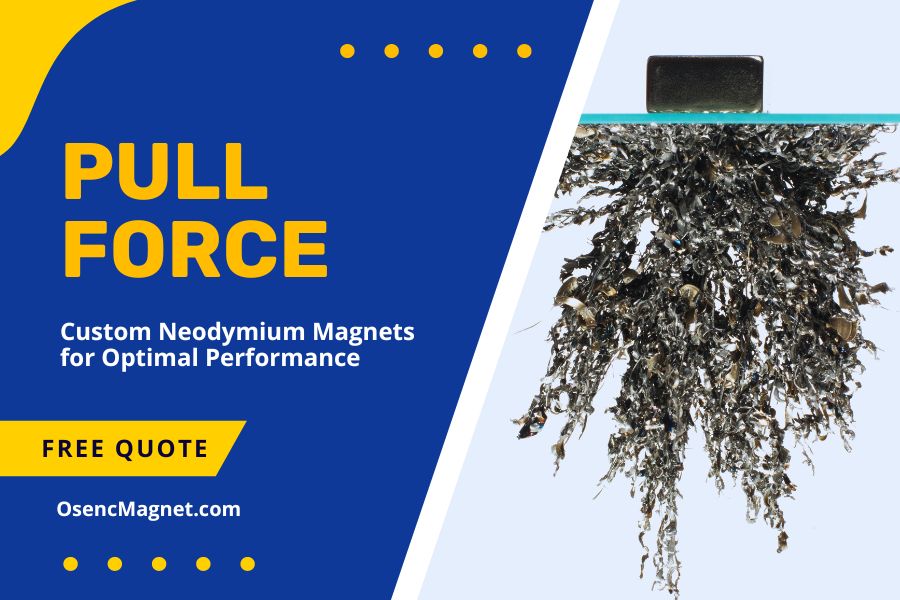
Pull force tells you how hard the magnet sticks to steel.
It’s measured in pounds or kilograms at the moment you separate the magnet from a flat steel plate.
Here’s the catch – Published pull force assumes perfect conditions.
- Thick steel.
- Clean surface.
- Full contact (0 air gap).
- Perfect alignment.
You’ll never see those conditions in real applications.
- Expect 50-70% of published force in actual use.
Thin steel can’t hold full magnetic flux – a magnet rated for 50 lbs might only pull 30 lbs on thin sheet metal.
Paint, powder coating, or anodizing creates an air gap – even 0.1mm of coating drops force by 20-30%.
Uneven surfaces prevent full contact – wood grain, textured plastic, or curved surfaces all reduce force.
How to use pull force specs:
Determine minimum force needed.
- Double it.
That’s your target pull force rating.
- Example: You need 10 lbs to hold a clipboard.
- Order magnets rated for 20 lbs pull force.
Testing beats calculations:
- Buy samples.
- Test them on your actual materials.
- Measure actual force with a spring scale.
Nothing beats real-world testing.
Material thickness, coating type, and surface finish all affect results.
Surface Gauss: The Detail Most People Ignore
Surface gauss measures field strength at the magnet face.
Most buyers focus on pull force and ignore this number.
That’s usually fine.
When surface gauss actually matters:
Reed switches and Hall sensors trigger at specific gauss levels. Your sensor datasheet lists the threshold.
Medical or scientific instruments need precise field strength at specific distances.
You’re troubleshooting why sensors behave inconsistently.
- For everything else, pull force tells you what you need to know.
- Two Numbers You Should Know (But Don’t Need to Specify)
Residual Induction (Br):
This measures the magnetic field density inside the material itself.
- Higher Br generally means higher pull force.
- The grade already accounts for this.
You don’t need to specify Br separately unless you’re an engineer designing magnetic circuits.
Coercivity (Hc and Hci):
This measures resistance to demagnetization.
- Temperature-rated grades automatically have higher coercivity.
- That’s how they survive heat.
Again, the grade letter (M, H, SH) already accounts for this.
You don’t need to specify it separately.
When these numbers matter:
You’re designing motors or generators with complex magnetic circuits.
You need to verify a supplier’s material actually meets grade specifications.
You’re reverse-engineering a competitor’s product.
- For standard holding, sensing, or attachment applications, ignore these parameters.
Quick Decision Guide
Choosing grade:
- Space is tight → Use N45 or higher
- Weight matters → Use N45 or higher
- Cost matters more than size → Use N35 or N42
- You need high-temperature resistance → Start with N35H or N38H
Choosing temperature rating:
- Indoor, room temperature → Standard N grade (80°C max)
- Outdoor, variable weather → M grade (100°C max)
- Hot environments, motors, automotive → H or SH grade (120-150°C max)
- Extreme heat applications → UH or EH grade (180-200°C max)
Choosing size for required force:
- Don’t calculate. Test.
- Order 3-4 different sizes. Test them on your actual materials.
- Pick the smallest size that provides comfortable margin.
- The $30 you spend on samples saves weeks of redesign.
What to Actually Tell Your Supplier
Don’t overthink your first order.
You need four specifications:
- Shape and dimensions (disc 20mm diameter x 5mm thick)
- Grade with temperature rating (N42M)
- Magnetization direction (through thickness)
- Coating type (nickel)
Everything else is secondary for most applications.
Your supplier will ask questions if they need more information.
Answer them.
- Don’t volunteer specifications you don’t understand.
Next, we’ll cover the parameters that keep your magnets from corroding to dust.
Thermal Parameters: Don’t Let Heat Kill Your Magnets
Here’s what nobody tells you about neodymium magnets.
Heat destroys them permanently.
- A magnet that gets too hot doesn’t just weaken temporarily.
- It loses strength forever. Even after it cools down.
This catches new buyers off guard. You order magnets, they work perfectly at room temperature, then fail in actual use because you didn’t account for heat.
Let’s fix that.
Maximum Operating Temperature: The Line You Can’t Cross
Every magnet grade has a temperature limit.
Cross it and the magnet starts dying.
- Standard N42 = 80°C (176°F)
- N42M = 100°C (212°F)
- N42H = 120°C (248°F)
- N42SH = 150°C (302°F)
- N42UH = 180°C (356°F)
- N42EH = 200°C (392°F)
Notice the pattern.
Same base grade (42), different temperature limits.
What happens when you exceed the limit:
- The magnet loses 5-10% of its strength. Permanently.
You won’t notice immediately.
The magnet still works.
It still sticks to steel.
But it’s weaker now.
And it keeps getting weaker each time temperature spikes.
- After months of heat cycles, your magnet might be 30-40% weaker than when new.
Where Heat Actually Comes From
Most buyers only think about ambient temperature.
Big mistake.
Your magnet’s actual temperature includes:
- Ambient air temperature
- Heat from motors or electronics
- Friction between moving parts
- Solar heating on dark surfaces
- Heat trapped in enclosures
- Electrical resistance heating
Real example:
Your product sits in a warehouse.
Ambient = 25°C.
No problem, right?
Wrong.
- Summer afternoon. Metal roof. No AC. Warehouse hits 40°C.
- Your product has a black plastic case. Add 15°C from solar heating.
- Electronics inside generate heat. Add another 10°C.
- Total = 65°C.
- You just exceeded the 60°C you thought was your max.
Your standard N42 magnets (80°C limit) are close to their edge.
A few degrees more and they start degrading.
How to Calculate Your Real Temperature
Take your worst-case scenario. Not typical. Not average. Worst case.
Start with ambient:
- Indoor climate controlled = 25°C
- Indoor unconditioned = 40°C
- Outdoor moderate climate = 45°C
- Outdoor hot climate = 50°C
- Inside vehicles = 70°C
Add heat sources:
- Dark colored housing in sun = +15-20°C
- Electronics/motors running = +10-30°C
- Enclosed space with poor ventilation = +10-15°C
- Direct contact with hot components = +20-50°C
Add safety margin:
- Always add 15-20°C on top of your calculation.
- Things get hotter than you expect. Sensors fail. Ventilation gets blocked. Heat sinks don’t work as well as designed.
Example calculation:
- Magnetic phone mount for cars.
- Dashboard in summer = 70°C base
- Black plastic mount = +15°C
- Total = 85°C
- Safety margin = +15°C
- Design temperature = 100°C
You need M grade minimum. H grade would be smarter.
The Temperature Coefficient: Why Magnets Weaken When Hot
Even below the maximum temperature, magnets lose strength when heated.
This loss is temporary.
The magnet recovers when it cools.
Neodymium magnets lose about 0.11% strength per degree Celsius.
Here’s what that means in practice:
- Your magnet at 20°C pulls 100 lbs.
- Same magnet at 80°C pulls 93 lbs.
- That’s a 7% drop (60 degrees × 0.11% per degree).
When this matters:
Precision sensors calibrated at room temperature read differently when hot.
Holding force that works fine cold might fail when the device heats up.
Motors lose torque as they warm up during operation.
When it doesn’t matter:
You designed with 2x safety margin on holding force.
Your application doesn’t need precision.
Temperature stays relatively constant.
Curie Temperature: The Point of No Return
Curie temperature is around 310-340°C for neodymium magnets.
- Above this temperature, the magnet stops being magnetic.
Completely.
Instantly.
The atomic structure that creates magnetism falls apart.
You probably won’t reach Curie temperature in normal use.
But you might hit it during manufacturing or assembly.
Dangerous operations:
- Soldering near magnets (300-400°C at the iron tip)
- Powder coating ovens (180-200°C, but localized hot spots can spike)
- Hot glue guns held too long in one spot
- Ultrasonic welding that generates localized heat
- Laser cutting or engraving
If you heat a magnet above Curie temperature:
It’s gone, and you can’t fix it.
The magnet becomes a piece of non-magnetic metal.
You need specialized equipment to re-magnetize it.
Most manufacturers won’t bother.
You’ll just buy new magnets.
How to protect magnets during assembly:
- Keep soldering irons away. Use mechanical fasteners instead.
- If you must solder, keep irons at least 10mm from magnets and work quickly.
- Test powder coating temperatures first. Some ovens run hotter than their settings indicate.
- Use low-temperature adhesives when possible (cyanoacrylate, epoxy, urethane).
- Remove magnets before operations involving high heat. Install them last.
Thermal Cycling: The Hidden Killer
Temperature changes stress magnets.
The magnet material expands and contracts at a different rate than the coating.
This creates micro-cracks in the coating over time.
Each heat-cool cycle:
- Coating gets stressed
- Small cracks form
- Moisture enters through cracks
- Corrosion starts under the coating
- Coating lifts and peels
You might not see damage for months.
Then suddenly the coating fails and corrosion spreads rapidly.
High-risk scenarios:
- Outdoor installations (day/night cycles)
- Automotive applications (engine heat cycles)
- Equipment shipped between climates
- Products stored in uncontrolled warehouses
How to handle thermal cycling:
- Choose coatings with good adhesion (nickel is better than zinc)
- Specify thicker coatings for cycling environments (20+ microns)
- Consider epoxy coating for extreme cycling (better flexibility)
- Add conformal coating or potting for complete protection
- Test samples through 50-100 heat cycles before production
Common Temperature Mistakes
Mistake 1: Using ambient temperature as design temperature
Fix: Calculate actual magnet temperature including all heat sources.
Mistake 2: Ordering standard N grade for outdoor use
Fix: Outdoor means temperature swings. Use M or H grade minimum.
Mistake 3: Assuming room-temperature pull force applies when hot
Fix: Reduce expected force by 10-15% for applications that heat up.
Mistake 4: Forgetting about manufacturing heat
Fix: Check every assembly operation for heat exposure.
Mistake 5: No safety margin on temperature rating
Fix: If you calculated 95°C max, don’t order 100°C rated magnets. Go to 120°C.
Quick Temperature Selection Guide
Your application runs cool (0-40°C):
- Standard N grade works fine
- Focus on cost and pull force
- Temperature isn’t your concern
Your application runs warm (40-80°C):
- Standard N grade might work but you’re close to the edge
- M grade adds safety for minimal cost
- Worth the upgrade for reliability
Your application runs hot (80-120°C):
- H grade minimum
- SH grade if you want margin
- Standard grades will fail
Your application runs very hot (120°C+):
- UH or EH grade required
- Expect to pay 2-3x standard magnet prices
- Consider if alternative magnet materials make more sense
Your application has extreme temperature swings:
- Pick grade based on maximum temperature
- Add 20°C to your calculated max
- Upgrade coating specifications
- Test thermal cycling before production
What to Tell Your Supplier
Be specific about temperature.
- Don’t say “it gets warm.” Say “maximum 95°C during operation.”
- Don’t say “outdoor use.” Say “Arizona installation, full sun exposure, calculated 110°C worst case.”
Give numbers. Suppliers can’t help you with vague descriptions.
Information your supplier needs:
- Minimum operating temperature (if below freezing)
- Maximum operating temperature (worst case)
- Whether temperature is constant or cycling
- Heat sources in your application
- Whether magnets contact hot components directly
They’ll recommend the right grade and coating based on real numbers.
Guess wrong about temperature and your magnets fail in the field.
Guess right and they last for years.
Next, we’ll cover physical parameters – making sure your magnets actually fit.
Physical Parameters: Making Sure They Actually Fit
You can order the perfect grade with the right temperature rating.
And still end up with magnets you can’t use.
- Because they don’t fit.
- Or they’re magnetized wrong.
- Or the tolerances are off.
Physical parameters determine whether your magnets work in the real world.
Let’s make sure you get this right.
Shape: More Than Just Appearance
Neodymium magnets come in standard shapes.
- Disc – flat cylinder, diameter larger than thickness
- Block – rectangular with six flat faces
- Ring – disc with a hole through the center
- Arc – curved segment, slice of a ring
- Cylinder – rod shape, length larger than diameter
- Sphere – ball with no flat surfaces
Pick the wrong shape and everything else doesn’t matter.
Discs work best for:
- Holding against flat surfaces
- Cabinet closures and latches
- Sensor triggering
- General attachment applications
The flat face gives you maximum contact area – more contact = more holding force.
Blocks work best for:
- Linear arrangements (row of magnets)
- Channel assemblies
- Mounting on multiple sides
- Applications needing flat surfaces in specific orientations
Rings work best for:
- Mounting on shafts or bolts
- Speaker assemblies
- Bearings and bushings
- Applications where center access matters
The hole lets you slide the magnet onto existing hardware.
Arcs work best for:
- Motors and generators
Anything rotating
Applications following curved surfaces
You can’t make a motor with disc magnets. The geometry doesn’t work.
Cylinders work best for:
- Reed switch activation
- Insertion into holes or tubes
- Applications needing reach into narrow spaces
Think of cylinders as directional – the magnetic field projects from the ends.
Spheres work best for:
- Toys and novelty items
- Pivot joints allowing rotation
- Demonstrations
Spheres are terrible for precision applications – you can’t control their orientation.
Here’s what most buyers don’t realize:
- Shape affects magnetic performance, not just fit.
Thin shapes demagnetize easier than thick shapes.
- A 20mm × 1mm disc needs higher grade material than a 20mm × 5mm disc to resist self-demagnetization.
The ratio of thickness to diameter matters.
Engineers call this the permeance coefficient.
- You just need to know: thicker in the magnetization direction = more stable.
Dimensions: Getting the Size Right
Dimensions seem straightforward. They’re not.
Common dimension mistakes:
- Ordering 10mm when you need 0.394 inches (actually 10.01mm)
- Forgetting to account for coating thickness
- Not considering tolerance stackup with mating parts
- Assuming catalog dimensions are exact
How to specify dimensions:
- Use millimeters. The magnet industry works in metric.
- Don’t convert from inches and round.
- 1/4 inch = 6.35mm, not 6mm.
Dimension format by shape:
- Disc: diameter × thickness (20mm × 5mm)
- Block: length × width × height (30mm × 10mm × 5mm)
- Ring: outer diameter × inner diameter × thickness (20mm × 8mm × 5mm)
- Cylinder: diameter × length (6mm × 25mm)
Always specify which dimension is the magnetization direction.
A 20mm × 5mm disc magnetized through thickness behaves completely differently than the same disc magnetized through diameter.
Size affects performance in ways you might not expect:
- Doubling diameter increases pull force by roughly 4x (not 2x)
- Doubling thickness increases pull force by roughly 2.5x (not 2x)
- A 20mm disc pulls much harder than two 10mm discs of the same total volume
You can’t just scale magnets proportionally and expect linear force changes.
How to pick the right size:
- Start with your space constraint – what’s the maximum size that fits?
- Calculate or estimate required pull force.
- Order 3-4 sample sizes around your target.
- Test them – pick the smallest that provides comfortable margin.
- Don’t guess – a $40 sample order saves you from $4,000 of wrong production magnets.
Tolerances: The Dimension Nobody Thinks About
Your magnet spec says 10mm diameter.
The actual magnet might be 9.95mm, or 10.08mm.
Both are probably within tolerance.
Standard tolerances for neodymium magnets:
- ±0.1mm for dimensions under 10mm
- ±0.1mm to ±0.15mm for dimensions 10-50mm
- ±0.2mm for dimensions over 50mm
These are typical.
Not universal – ask your supplier!
When tolerances matter:
- Magnets sliding into holes or channels (must account for tolerance)
- Magnets pressed into housings (tolerance affects press fit)
- Multiple magnets in precise arrays (tolerance causes alignment issues)
- Applications requiring matched pull force (size variation = force variation)
When tolerances don’t matter:
- Magnets glued to flat surfaces
General holding applications with margin
Rough positioning sensors
Tolerance stackup kills designs:
- Your magnet: 10mm ±0.1mm
- Your hole: 10.2mm ±0.1mm
- Your coating: 0.02mm per side (adds 0.04mm to diameter)
- Maximum magnet = 10.1mm + 0.04mm coating = 10.14mm
- Minimum hole = 10.2mm – 0.1mm = 10.1mm
Your magnet might not fit – even though the nominal dimensions look fine.
How to handle tolerances:
- Design with worst-case dimensions, not nominal
- Add clearance for coating thickness
- Specify tighter tolerances only where needed (costs more)
- Test fit with actual samples before production
Tighter tolerances cost money:
- Standard ±0.1mm = included in base price
- ±0.05mm = adds 10-20% to cost
- ±0.02mm = adds 30-50% to cost, requires grinding
Only specify tight tolerances where function requires it.
Again, these costs are not universal – ask your supplier.
Magnetization Direction: The Mistake That Ruins Everything
This is where most first-time buyers mess up.
You order perfect magnets. They arrive. You test them. They barely work.
Because they’re magnetized wrong.
Axial magnetization:
- Poles on the flat faces of discs or blocks
- North on one face, south on opposite face
- Field projects perpendicular to the face
This is the default for disc magnets. Unless you specify otherwise, you get axial.
Diametric magnetization:
- Poles on opposite sides of the curved surface
- North on one side, south on the other
- Field projects sideways through the diameter
Used for cylinders that rotate. The pole position rotates with the magnet.
Radial magnetization:
- Poles on inner and outer surfaces of rings
- Creates field that radiates outward or inward
- Required for most motor applications using ring or arc magnets
Through-thickness:
- Same as axial, but refers to blocks
- Poles on the two largest faces
- Most common for rectangular magnets
Multi-pole:
- Multiple north and south poles on one surface
- Alternating pattern
- Used for encoders, tachometers, and specialty motors
- Requires custom tooling. Expensive for small quantities.
Why this matters so much:
- A disc magnetized axially pulls hard on flat steel when you use the face.
- The same disc magnetized diametrically barely sticks when you use the face. The poles are on the rim.
An example that can happen:
Buyer orders 20mm × 5mm discs for holding against steel.
- Supplier assumes holding application means axial. Ships axial magnets.
- Buyer designed for diametric because they didn’t understand the difference.
- Magnets don’t work. Buyer blames supplier. Supplier blames buyer.
Nobody wins.
How to avoid magnetization mistakes:
- Always specify magnetization direction explicitly
- Include a drawing showing which surfaces should be N and S
- Use standard terminology (axial, diametric, radial)
- Ask supplier to confirm before manufacturing
Never assume. Never let the supplier assume.
What to tell your supplier:
Wrong: “Magnetized normally”
Right: “Axial magnetization, north pole on the 20mm diameter face”
Wrong: “Standard magnetization”
Right: “Through-thickness magnetization, north on largest face”
Include a simple sketch.
Draw an arrow showing magnetization direction.
Weight: The Parameter You Ignore Until It’s a Problem
Neodymium magnets are heavy.
- Density = 7.4 to 7.5 grams per cubic centimeter.
About the same as steel.
Heavier than aluminum or plastic.
When weight matters:
- Drones and aircraft (every gram counts)
- Wearable devices (comfort issues)
- Robotic end effectors (affects speed and accuracy)
- Shipping costs for large quantities
Quick weight estimates:
- 10mm diameter × 3mm disc = 1.7 grams
- 20mm diameter × 5mm disc = 11.5 grams
- 25mm diameter × 10mm disc = 37 grams
Weight scales with volume.
Double all dimensions = 8x weight.
How to reduce weight without losing performance:
- Use higher grade material (N52 vs N35) for same force in less volume
- Use ring magnets instead of solid discs where possible
- Optimize shape for your specific application
- Consider magnet arrays that concentrate field efficiently
Weight affects installation:
- Heavy magnets need mechanical retention, not just adhesive
- Vibration can dislodge heavy magnets relying on magnetic attraction alone
- Mounting orientation matters (vertical vs horizontal)
Chamfers and Edges: The Detail That Prevents Chipping
Neodymium magnets are brittle.
Sharp edges chip easily during handling and installation.
Chamfer options:
- No chamfer (sharp 90° edges) = cheapest, most fragile
- 0.2mm chamfer = slight edge break, helps prevent chipping
- 0.3-0.5mm chamfer = better protection, adds minimal cost
- Radiused edges = maximum protection, adds more cost
When you need chamfers:
- Magnets handled frequently during assembly
- Magnets that snap together (impact stress)
- Magnets pressed into housings (edge contact during insertion)
- Applications with vibration (edges rub and chip)
Standard production often includes small chamfers automatically.
If you have special requirements, ask your supplier.
Custom Shapes: When Standard Won’t Work
Sometimes you need something weird.
Triangular magnets. Magnets with multiple holes. Complex curves.
Custom shapes are possible. But expensive.
Custom shape costs:
- Tooling charges: $500-$5,000 depending on complexity
- Minimum quantities: Often 1,000+ pieces to justify tooling
- Lead time: Add 4-8 weeks for tool manufacturing
- Unit price: 2-10x standard shapes
Before ordering custom shapes:
- Can you achieve the same function with standard shapes?
- Can you use multiple small magnets instead of one complex shape?
- Does the performance gain justify the cost?
- Will you need this quantity to make tooling worthwhile?
Sometimes custom shapes are worth it:
- High-volume production (spreads tooling cost)
- Unique application requirements (no other solution works)
- Competitive advantage (better performance than standard shapes)
What to Actually Specify
Your supplier needs five physical specifications:
- Shape: “Disc” or “block” or “ring” – be specific
- Dimensions: “20mm diameter × 5mm thickness” – include units, be precise
- Tolerances: “Standard” or “±0.05mm on diameter” – only tighten where needed
- Magnetization direction: “Axial, north on top face” – never leave this ambiguous
- Special features: “0.2mm chamfer on edges” or “countersunk hole 3mm diameter” – if applicable
Don’t forget to mention:
- Maximum and minimum dimensions if they matter
- Which dimension is critical for your application
- Whether dimensions are before or after coating
Next, we’ll cover coatings and corrosion protection – because unprotected magnets corrode to dust in weeks.
Durability and Protection: Stop Your Magnets From Corroding to Dust
Unprotected neodymium magnets corrode fast.
- We’re talking weeks in humid conditions. Days if they get wet.
- The iron content rusts.
- The rust expands.
- The surface flakes away.
- The magnet loses material and strength.
Eventually it crumbles to orange powder.
This surprises buyers who assume magnets are indestructible.
- They’re not – They’re reactive metal that needs protection.
Every neodymium magnet you buy has some form of coating.
But not all coatings work for all applications.
Let’s make sure yours survives.
Why Neodymium Corrodes So Aggressively
Neodymium-iron-boron alloy contains roughly 70% iron.
Iron rusts. You know this.
But neodymium magnets rust faster than plain steel because the material is porous at a microscopic level.
More surface area exposed to moisture and oxygen.
What corrosion looks like:
- Week 1: Small rust spots appear
- Week 2-3: Spots grow and spread
- Month 1-2: Surface coating bubbles and lifts
- Month 3-6: Visible flaking and material loss
- Month 6-12: Structural failure in humid environments
The timeline speeds up with moisture, salt, temperature, and handling damage.
Coating Types: What Actually Protects Your Magnets
Five coating types dominate the market.
Each has strengths and weaknesses.
Nickel (NiCuNi) – The Standard
Three layers: nickel, copper, nickel.
This is what you get unless you specify otherwise.
- Appearance: Bright silver, smooth finish
- Corrosion resistance: Good for indoor use
- Durability: Handles normal handling
- Cost: Included in base price
- Conductivity: Electrically conductive
Use nickel for general indoor applications.
Office equipment, displays, closures, consumer products.
Don’t use nickel for wet environments or if users have nickel allergies.
Zinc – The Budget Option
Single layer of zinc plating.
- Appearance: Dull gray or bluish
- Corrosion resistance: Moderate, worse than nickel
- Durability: Softer, scratches easier
- Cost: Slightly cheaper than nickel
- Conductivity: Conductive but less than nickel
Zinc sacrificially corrodes to protect the base material. Like galvanized steel.
Use zinc for hidden applications where cost matters and environment is controlled.
Don’t use zinc for visible applications or anywhere appearance matters.
Epoxy – The Chemical Resistant Option
Polymer coating, usually black.
- Appearance: Matte black, sometimes gray
- Corrosion resistance: Excellent, best chemical resistance
- Durability: Soft surface, scratches easily
- Cost: 10-20% more than nickel
- Conductivity: Non-conductive (electrical insulator)
Epoxy excels in wet, humid, or chemically aggressive environments.
Use epoxy for outdoor installations, marine applications, chemical exposure, anywhere requiring electrical insulation.
Don’t use epoxy where abrasion or surface wear occurs.
Gold – The Premium Option
Thin gold layer over nickel base.
- Appearance: Bright gold, jewelry-quality finish
- Corrosion resistance: Excellent
- Durability: Good, gold is soft but nickel base provides strength
- Cost: 3-5x standard nickel
- Conductivity: Excellent electrical conductivity
Use gold for medical devices, electronics requiring reliable conductivity, visible luxury applications.
Don’t use gold unless performance or appearance justifies the cost.
Parylene – The Specialty Option
Vapor-deposited polymer, extremely thin and uniform.
- Appearance: Clear, preserves base material appearance
- Corrosion resistance: Excellent
- Durability: Good chemical resistance
- Cost: 2-4x standard nickel, requires specialized equipment
- Conductivity: Non-conductive
- Biocompatibility: Often used in medical applications
Use parylene for medical implants, sensitive electronics, applications requiring pinhole-free coating.
Don’t use parylene for general applications. The cost isn’t justified.
Coating Thickness: How Much Protection You Actually Get
Thicker coating = better protection. Also = more dimensional size.
Standard coating thickness by type:
- Nickel (NiCuNi): 10-20 microns total
- Zinc: 5-15 microns
- Epoxy: 15-25 microns
- Gold: 1-5 microns over nickel base
- Parylene: 10-25 microns (precisely controllable)
For reference: 10 microns = 0.01mm.
A human hair is about 70 microns thick.
How thickness affects your design:
Coating covers all surfaces.
- A disc coated on all sides gains twice the coating thickness in diameter.
- Example: 10mm disc with 15-micron coating = 10.03mm actual diameter.
This matters for tight-tolerance assemblies.
When to specify thicker coating:
- Harsh outdoor environments (request 20-25 microns)
- Marine or salt spray exposure (request 25+ microns)
- Long service life requirements (thicker = longer protection)
When standard thickness works:
- Indoor, climate-controlled environments
- Short-term applications (less than 2 years)
- Applications where magnets are further protected by enclosures
Thicker coating costs more.
Only specify it where environmental conditions demand it.
Salt Spray Testing: The Number That Predicts Survival
Salt spray testing exposes magnets to continuous salt water mist at elevated temperature.
Results are reported in hours survived before corrosion appears.
Typical ratings:
- 48 hours = minimum acceptable for indoor use
- 72 hours = good for general applications
- 96 hours = better protection
- 120-200+ hours = enhanced for outdoor/harsh environments
What the numbers actually mean:
These tests create accelerated aging in extreme conditions. Far worse than most real environments.
- A 72-hour rating doesn’t mean the magnet fails after 72 hours in your application.
- It means it survived 72 hours of continuous salt spray.
- Real-world correlation is rough.
- A 72-hour magnet might last years indoors or months outdoors depending on actual conditions.
Use salt spray ratings for comparison:
- 200 hours is definitely better than 72 hours.
- How much better in your specific environment?
- Hard to say precisely.
When to care about salt spray ratings:
- Outdoor installations (specify 96+ hours minimum)
- Marine environments (specify 200+ hours)
- Industrial environments with chemical exposure (specify 120+ hours)
- Anywhere moisture is constant (specify 96+ hours)
When standard ratings work:
- Indoor, climate-controlled spaces
- Dry environments
- Applications with secondary protection (potting, enclosures)
Coating Adhesion: The Property Nobody Tests Until Coating Fails
Coating must stick to the magnet surface.
Sounds obvious. But adhesion varies dramatically between suppliers.
Poor adhesion causes:
- Coating chips during handling
- Coating peels at edges and corners
- Coating lifts due to thermal cycling
- Coating delaminates under impact or vibration
- Once coating fails at one spot, corrosion starts there and spreads underneath the remaining coating.
What causes poor adhesion:
- Inadequate surface preparation before coating
- Contamination on magnet surface
- Wrong coating process parameters
- Thermal expansion mismatch between coating and magnet
- Manufacturing shortcuts to reduce cost
How to evaluate adhesion:
- Cross-hatch tape test (scribes grid, applies tape, measures how much coating lifts)
- Thermal cycling test (heat/cool cycles reveal adhesion failures)
- Impact testing (drop test or impact hammer)
Most buyers never test adhesion.
They trust the coating stays on.
Then it doesn’t.
What you can do:
- Order samples for harsh-environment applications
- Test samples through realistic conditions before production
- Drop them, bang them together & temperature cycle them
- Examine edges and corners for coating integrity
Request adhesion test data for critical applications.
Quality suppliers can provide it.
Budget suppliers will say “our coating is good” and change the subject.
Environmental Matching: Picking Coating for Your Conditions
Different environments need different protection.
Indoor, climate controlled (offices, homes, retail):
- Nickel coating, standard thickness
- 48-72 hour salt spray rating
- No special requirements
Indoor, unconditioned (warehouses, garages):
- Nickel coating, standard to enhanced thickness
- 72-96 hour salt spray rating
- Temperature cycling consideration if environment swings
Outdoor, protected from direct weather:
- Nickel or epoxy coating
- 96-120 hour salt spray rating
- Consider UV resistance if sun exposure
Outdoor, exposed to weather:
- Epoxy coating preferred
- 120-200 hour salt spray rating
- Thicker coating (20-25 microns)
Marine or salt spray environments:
- Epoxy coating required
- 200+ hour salt spray rating
- Maximum coating thickness
- Consider secondary protection (potting)
Chemical exposure:
- Epoxy coating
- Chemical compatibility testing required
- May need encapsulation beyond coating
Medical or body contact:
- Gold or parylene coating
- Biocompatibility documentation required
- Nickel causes allergies in some people
Submerged or continuous wet:
- Epoxy with secondary sealing
- Even best coatings have limits underwater
- Consider potting or hermetic sealing
Edge Coverage: Where Coatings Fail First
Sharp edges and corners are hard to coat evenly.
Coating tends to be thinner at edges.
Sometimes edges get no coating at all.
Edges also take the most abuse during handling.
They contact surfaces, bang into things, and chip first.
The edge problem:
- Magnets snap together = edge impact = coating chips
- Magnets pressed into housings = edge contact = coating scrapes
- Magnets dropped = edge contact = coating cracks
Once an edge chips, corrosion starts immediately.
Solutions:
- Specify chamfered edges
- Request enhanced edge coating for critical applications
- Avoid sharp edges in design if possible
- Handle magnets carefully during assembly
Chamfered edges coat more uniformly and chip less easily.
The small cost is worth it for applications with handling or impact.
Common Coating Failures and How to Prevent Them
Failure 1: Pinholes in coating
- Tiny holes in coating allow moisture to reach base material. Corrosion starts inside these holes and spreads.
- Prevention: Thicker coating, better process control, secondary sealing if environment is aggressive.
Failure 2: Coating peels at edges
- Poor edge coverage or adhesion allows coating to lift. Moisture enters and spreads.
- Prevention: Chamfered edges, adhesion testing, enhanced edge coating.
Failure 3: Coating cracks from thermal cycling
- Temperature changes stress coating due to different expansion rates. Cracks form over time.
- Prevention: Use epoxy coating for thermal cycling applications. Test samples through expected cycle count.
Failure 4: Coating damage during assembly
- Handling, pressing, or impact during installation damages coating.
- Prevention: Handle carefully, use assembly fixtures that don’t contact coated surfaces, chamfer edges.
Failure 5: Coating incompatible with adhesive
- Some adhesives attack certain coatings chemically.
- Prevention: Test adhesive compatibility on coated samples before production. Cyanoacrylate works with most coatings. Some epoxies can be aggressive.
Secondary Protection: When Coating Isn’t Enough
Coating provides the first line of defense.
For harsh environments, add secondary protection.
Potting or encapsulation:
Embed magnets completely in epoxy, urethane, or silicone.
The potting compound seals the entire assembly. Moisture can’t reach magnets.
Use for marine applications, outdoor electronics, harsh industrial environments.
Conformal coating:
Apply thin polymer coating over entire assembly including magnets.
Adds another barrier layer beyond the magnet coating.
Common in electronics exposed to moisture.
Sealed housings:
Enclose magnets in sealed, gasketed housings.
Keeps environmental exposure away from magnets entirely.
Use for underwater applications, outdoor installations, chemically aggressive environments.
Desiccants:
Include moisture-absorbing packets in sealed assemblies.
Controls humidity inside the enclosure.
Simple addition that extends coating life significantly.
What to Tell Your Supplier
Be specific about your environment.
“Indoor use” could mean climate-controlled office or hot warehouse. Huge difference.
Information your supplier needs:
- Operating environment (indoor/outdoor, temperature range, humidity)
- Exposure to moisture (dry/humid/wet/submerged)
- Chemical exposure if any
- Expected service life
- Handling requirements during assembly
- Any special requirements (biocompatibility, electrical properties, appearance)
Example good specification:
- “Outdoor installation, Arizona desert climate, full sun exposure, temperature range -10°C to 60°C, no direct water contact but high UV and temperature cycling. Minimum 120-hour salt spray rating. Epoxy coating preferred.”
Example bad specification:
- “Outdoor use, needs to last.”
Give your supplier information they can work with.
Quick Coating Decision Guide
- General indoor applications: Standard nickel coating, 48-72 hour salt spray
- Outdoor but protected: Nickel or epoxy, 96-120 hour salt spray
- Outdoor exposed: Epoxy coating, 120-200 hour salt spray
- Marine or salt spray: Epoxy coating, 200+ hour salt spray, consider secondary protection
- Chemical exposure: Epoxy coating with compatibility testing
- Medical or body contact: Gold or parylene, biocompatibility documentation
- Electrical insulation required: Epoxy or parylene coating
- Visible luxury application: Gold coating for appearance
- Budget critical, controlled environment: Zinc coating acceptable
- Default when unsure: Nickel coating works for most applications
Testing Your Coating Before Production
Don’t trust supplier claims blindly.
Test coating performance on samples before ordering thousands of magnets.
Simple tests you can do:
- Salt water soak (24-48 hours in salt water, examine for corrosion)
- Scratch test (scrape coating with knife, evaluate adhesion and thickness)
- Drop test (drop on concrete, examine edge damage)
- Temperature cycling (freezer to oven 10 cycles, check for cracking)
These aren’t formal certification tests. But they reveal obvious problems.
A coating that fails your simple tests will definitely fail in production.
When to invest in formal testing:
- High-volume production (thousands or millions of magnets)
- Safety-critical applications
- Long warranty periods
- Harsh environments where failure is expensive
Salt spray testing, adhesion testing, and thermal shock testing cost $500-2000 per round.
That’s cheap insurance compared to field failures.
Next, we’ll cover quality and certification – making sure you actually receive what you ordered.
Quality and Certification: Making Sure You Get What You Paid For
Here’s an uncomfortable truth about the magnet industry.
Not all suppliers deliver what they promise.
- Some ship N42 magnets that barely meet N35 specifications.
- Some provide salt spray ratings that were never actually tested.
- Some substitute materials without telling you.
You need to verify. Trust isn’t enough.
Grade Consistency: The Strength Lottery
You order N52 magnets.
The spec sheet says N52.
The invoice says N52.
But are they actually N52?
The grade range problem:
- N52 means BHmax between 50-52 MGOe.
- That’s a range, not a single value.
- Some suppliers optimize for cost.
- They produce material at 50.1 MGOe.
- Technically N52. Barely.
Other suppliers target the middle or high end.
They deliver 51 MGOe material consistently.
Both say “N52” on the spec sheet.
Performance differs by 2%.
Why this matters:
If you designed assuming typical N52 performance (51 MGOe) and receive low-end material (50 MGOe), your application underperforms.
- If magnets vary within a batch, some units work fine while others fail testing.
- If magnets vary between batches, your product performance changes over time.
An example:
You build magnetic latches. Prototype uses magnets that pull 15 lbs. Perfect.
Production order arrives. Same spec. But these pull 13.5 lbs. Not enough.
Your design didn’t change. The magnets changed. They’re at the low end of grade spec instead of typical values.
Now you’re stuck with 10,000 weak magnets and production is stopped.
How to protect yourself:
- Request actual test data, not just grade designation.
- Ask for Br and Hci values measured on your specific batch.
- Specify minimum values: “Br minimum 1.42T” instead of just “N52.”
- Test incoming magnets, especially first orders from new suppliers.
- Use a gaussmeter to verify surface field strength matches expectations.
Building margin into designs:
Don’t design for typical values. Design for minimum spec values.
- If N52 range is 50-52 MGOe, design assuming 50 MGOe.
- Add safety margin on top of that.
Yes, this means slightly larger or more expensive magnets.
It also means your product always works.
Supplier Reliability: Not All Manufacturers Are Equal
Three tiers of magnet suppliers exist.
Tier 1: Quality-focused manufacturers
Own their production facilities. Control entire process from raw materials to finished magnets.
Consistent specifications batch to batch. Statistical process control. Documentation and traceability.
Higher prices. Worth it for critical applications.
Tier 2: Established distributors
Source from multiple manufacturers. May have some quality standards but less direct control.
Moderate consistency. Can usually provide test data. May substitute sources without notice.
Middle pricing. Acceptable for non-critical applications if you verify quality.
Tier 3: Commodity brokers
Buy wherever price is cheapest. No manufacturing capability. Minimal quality oversight.
High variation between batches. May not have actual test data. Substitutions common.
Lowest prices. High risk of quality problems.
How to identify supplier tier:
Ask if they manufacture or distribute. Manufacturing indicates more control.
Request facility certifications (ISO 9001 minimum for quality operations).
Ask about lot traceability. Can they trace your magnets to specific production runs?
Request previous test reports. Quality suppliers have documentation ready.
Check how they respond to technical questions. Knowledgeable or evasive?
You generally get what you pay for.
- The supplier offering 30% lower prices probably cuts corners somewhere.
- That might be acceptable for low-risk applications. It’s dangerous for critical ones.
Certificates of Conformance: Paper That Might Mean Nothing
A Certificate of Conformance (C of C) states that material meets specifications.
Almost every supplier provides them, but not all are meaningful.
What a good C of C includes:
- Specific material identification (lot number, batch code)
- Actual measured values for key parameters (Br, Hci, BHmax)
- Test methods used (ASTM standards, equipment type)
- Test date and conditions
- Signature of authorized person
- Traceability to source material
What a bad C of C includes:
- Generic statement “material meets N52 specifications”
- No actual measured values
- No traceability information
- Template document clearly used for multiple batches
The problem with certificates:
Anyone can type up a certificate. Verification is rare.
Some suppliers generate certificates without testing. They assume material is good.
Some suppliers test one sample from a large production run. That sample might not represent your batch.
Some suppliers copy previous certificates and change dates.
How to use certificates:
Request certificates for your specific batch, not generic material.
Compare actual values across multiple batches. Consistent numbers suggest real testing.
Ask questions about unexpected values. If Br suddenly jumped 5%, ask why.
For critical applications, verify certificates with independent testing.
Don’t assume a certificate guarantees quality. It’s documentation, not proof.
Independent Testing: Trust But Verify
For critical applications, test magnets yourself.
You need minimal equipment to catch obvious problems.
Basic testing you can do:
Surface gauss measurement:
- Equipment: Gaussmeter ($200-500 for basic models)
- Method: Place probe on magnet face, read field strength
- What it tells you: Verifies magnetization strength, catches weak magnets
Measure multiple samples.
Calculate average and standard deviation.
High variation indicates consistency problems.
Pull force testing:
- Equipment: Spring scale or force gauge ($50-200)
- Method: Attach magnet to steel plate, pull straight off, record force
- What it tells you: Verifies functional strength for your application
Test on your actual steel material, not random scrap.
Steel thickness and quality affect results.
Dimensional verification:
- Equipment: Digital calipers ($30-100)
- Method: Measure diameter, thickness, hole size
- What it tells you: Verifies tolerance compliance
Measure 10-20 samples.
Plot distribution.
Look for outliers or systematic errors.
Visual inspection:
- Equipment: Your eyes, maybe magnification
- Method: Examine coating quality, edge condition, surface defects
- What it tells you: Catches obvious manufacturing defects
Look for coating pinholes, chips, discoloration, cracks, uneven coating.
When to invest in professional testing:
- High-volume production (amortize testing cost over large quantities)
- Safety-critical applications (failure could injure people)
- Long warranty commitments (you own field failures)
- New supplier qualification (verify capability before committing)
Professional labs can test:
- Complete demagnetization curves at multiple temperatures
- Precise BHmax, Br, Hci measurements
- Salt spray testing to failure
- Coating adhesion and thickness
- Dimensional inspection with CMM equipment
Cost: $500-2000 per test round.
Worth it to avoid $50,000 production failures.
Batch Traceability: Knowing What You Actually Got
Every magnet should trace to a production batch with documented properties.
This enables quality control and failure investigation.
What traceability looks like:
- Magnets arrive with batch code on packaging.
- Batch code links to production date, source materials, test results.
If problems occur, you can identify which batches are affected.
Why traceability matters:
Quality problems rarely affect all magnets uniformly. Usually specific batches have issues.
Without traceability, a problem in one batch means scrapping all inventory. You can’t separate good from bad.
With traceability, you identify and quarantine affected batches. The rest continues to production.
Example:
You discover coating failures in assembled products. Six months after assembly.
With traceability: You identify the batch code. Check other products using that batch. Replace affected units. Continue using magnets from other batches.
Without traceability: You have no idea which magnets might fail. Replace everything or risk more failures. Either way, expensive.
How to establish traceability:
- Require batch codes on all packaging.
- Request batch-specific documentation for each delivery.
- Record batch codes in your receiving inspection.
- Link batch codes to finished product serial numbers or production dates.
- Maintain records for product lifetime plus warranty period.
RoHS and REACH Compliance: The Regulations You Can’t Ignore
If you sell products in Europe, US, or most developed markets, you need compliant materials.
Neodymium magnets must meet RoHS and REACH requirements.
RoHS basics:
Restricts hazardous substances in electrical and electronic equipment.
Key restricted substances: lead, mercury, cadmium, hexavalent chromium, certain flame retardants.
Neodymium magnet material itself is usually compliant.
Coatings can introduce restricted substances. Older zinc processes used hexavalent chromium.
REACH basics:
European regulation on chemical safety.
Requires registration of chemical substances. Restricts substances of very high concern.
The restricted substance list updates regularly. Yesterday’s compliant coating might not be compliant today.
Why you care:
Non-compliant components make your entire product non-compliant.
Using non-RoHS magnets in a RoHS-required product violates regulations regardless of magnet size.
Consequences: Sales blocked, recalls required, fines possible, reputation damage.
Your responsibility:
You cannot transfer compliance responsibility to your supplier.
If they provide non-compliant material and you use it, you face the consequences.
You must verify compliance and maintain documentation.
How to ensure compliance:
- Request RoHS and REACH declarations from suppliers.
- Verify declarations include specific regulation references.
- Check declaration dates. Old declarations don’t reflect current restrictions.
- Request updated declarations annually or when regulations change.
- For critical markets, request independent lab testing (XRF analysis for RoHS substances).
- Maintain compliance documentation for regulatory audits.
ISO 9001 and Quality Systems: What Certifications Actually Mean
ISO 9001 certification indicates a quality management system exists.
It doesn’t guarantee product quality. It means the supplier has documented processes.
What ISO 9001 tells you:
- Procedures are documented and followed.
- Some level of process control exists.
- Nonconformances are tracked.
- Regular audits occur.
What ISO 9001 doesn’t tell you:
- Whether products actually meet specifications.
- How tight process control is.
- How good the quality culture is.
- ISO 9001 is better than nothing, but not a guarantee.
Other certifications that might matter:
- IATF 16949 – Automotive quality standard. Stricter than ISO 9001.
- AS9100 – Aerospace quality standard. Even stricter.
- ISO 13485 – Medical device quality standard. Required for medical applications.
- FDA registration – Required for US medical device suppliers.
Ask for relevant certifications if your industry requires them.
First Article Inspection: Catching Problems Before Production
First Article Inspection (FAI) verifies that a new production setup produces conforming parts.
Standard practice in aerospace and automotive. Rare in consumer products. Should be more common.
What FAI includes:
- Complete dimensional inspection of first production samples.
- Material testing and verification.
- Visual inspection for defects.
- Functional testing as applicable.
- Documentation of all measurements.
When to require FAI:
- First order from new supplier.
- New magnet design or specification.
- Change in supplier’s manufacturing process.
- After significant quality issues.
How FAI works:
- You or your supplier performs detailed inspection on first production samples.
- Results are documented in FAI report.
- Production doesn’t proceed until FAI is approved.
- This catches setup errors before you receive thousands of wrong parts.
Cost:
- Adds time and cost to first production run.
- Much cheaper than scrapping production quantities.
- Incoming Inspection: Your Last Defense
- Quality control shouldn’t end when magnets arrive.
- Verify before the magnets enter your production.
Minimum incoming inspection:
- Visual inspection (coating condition, obvious defects).
- Sample dimensional check (measure random samples).
- Sample functional test (surface gauss or pull force on random samples).
- Verify batch codes and documentation.
Enhanced incoming inspection for critical applications:
Measure all samples for critical dimensions.
Test all samples for surface gauss.
Perform statistical analysis on measurements.
Compare results to specification limits and previous batches.
When to reject a batch:
Measurements fall outside specifications.
High variation within the batch (poor consistency).
Coating defects present in multiple samples.
Documentation missing or questionable.
The cost of skipping incoming inspection:
Bad magnets enter production. Problems discovered during assembly or testing.
Production stops while you wait for replacement magnets.
Labor wasted assembling products that will fail.
Customer returns if defects reach the field.
Incoming inspection costs 1-5% of material cost. Production disruptions cost 100-1000% of material cost.
Do the math.
Final Thoughts: Order Smart, Not Just Cheap
You’ve learned what every parameter means.
Now the real work begins: applying this knowledge to your specific situation.
Start with these steps:
- Define your requirements clearly (temperature, environment, force needed)
- Order samples in multiple variations (test before committing)
- Test samples in actual conditions (not just on your desk)
- Verify supplier quality systems (certifications, test data, traceability)
- Start small (initial production order, not six months of inventory)
- Implement incoming inspection (catch problems early)
- Build relationships with reliable suppliers (consistency matters)
Remember:
- The cheapest magnet that fails costs more than the expensive magnet that works.
- Specifications on paper mean nothing without verification.
- Your supplier’s problems become your problems if you don’t catch them.
- Testing costs pennies. Field failures cost dollars.
You’re ready to order custom neodymium magnets with confidence.
- Order samples. Test them. Ask questions. Verify quality.
- And if a supplier can’t answer your questions or provide documentation, find a different supplier.