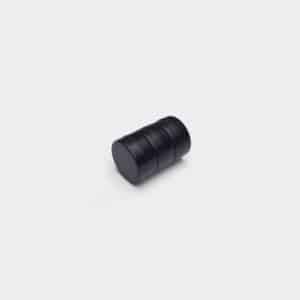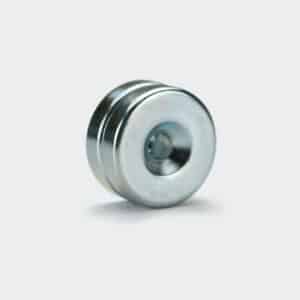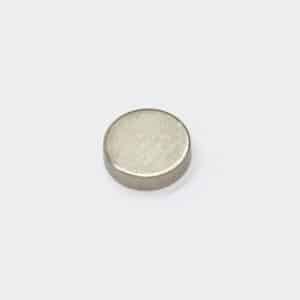


We supply customized stepped Neodymium magnets.
Also called T-shape, shoulder, or convex magnets.
They feature two concentric cylindrical sections of different diameters, creating a shoulder between them.
Typical geometry:
Larger base diameter with smaller head diameter, though inverted configurations are also available.
The shoulder acts as a mechanical stop.
It controls insertion depth into a counterbored hole.
But does not require adhesive for depth positioning.
The magnet seats against the shoulder of the mating bore.
Common in sensor assemblies, magnetic catches, tooling, and fixtures.
Those applications require repeatable positioning and easy removal/replacement.
Magnetization can be axial (through both sections).
Or diametral, depending on application requirements.
The Engineering Logic: Why the “Step”?
This explains the functional advantage over a simple cylinder.
1. Precision Depth Control (Mechanical Stop):
If you are pressing a magnet into a housing:
The Problem:
– A standard rod magnet can be pushed too deep or set unevenly.
The Solution:
– The wider base of the Stepped Magnet hits the surface of your component.
– This prevents the magnet from going any further.
– And guarantees consistent Z-axis positioning across thousands of units.
2. Mistake-Proof Assembly:
The Function:
– The T-shape allows for “One-Way” insertion.
The Benefit:
– Assembly workers cannot install the magnet backward (polarity reversed).
– Because the physical shape won’t fit the hole in the wrong direction.
Geometric Definitions: What to Measure
Because there are two diameters and two lengths, clarity is key.
To manufacture this part, we define the dimensions as follows:
– Base Diameter (D1): The wider cylinder.
– Tip Diameter (D2): The narrower cylinder.
– Base Height (H1): The thickness of the wide part.
– Tip Height (H2): The height of the narrow part (or Total Length).
– Fillet Radius: The photo shows a very slight radius where the step meets; we can control this for strength.
Manufacturing Method (Lathe Turning)
Process:
– These intricate shapes are produced via CNC Turning (Lathe).
– Or Centerless Grinding from a larger block.
Concentricity:
– This is the most critical quality metric.
– We ensure the small diameter is perfectly centered on the large diameter (Concentricity < 0.05mm).
– In this way, it doesn’t jam during assembly.
Magnetization Orientation
Axial (Through Length):
– The standard orientation.
Configuration:
– Typically, the Tip is one pole (e.g., North).
– And the Base is the other (South).
Flux Concentration:
– The narrower tip provides a higher flux density (Gauss) area than the base.
Surface Coatings
Nickel (Ni-Cu-Ni):
– As shown.
– A hard, shiny finish.
– We pay special attention to the “inside corner” of the step.
– Ensure the plating does not crack or bubble in that tight crevice.
Zinc (Zn):
– Good for cost-sensitive mechanical parts.
Gold (Au):
– For electrical contacts (the T-shape is common in pogo-pins).
Applications
Sensors: The “Tip” fits into a small sensor window, while the “Base” provides a large surface for gluing.
Magnetic Catches: The step sits flush against a cabinet door face, while the body is hidden in the wood.
Electrical Connectors: Spring-loaded magnetic contacts.
Holding Fixtures: Jigs that require magnets to be seated at a precise height.
Ordering Guide: Critical Data
To quote this, please provide a drawing or the following 4 dimensions:
1). Large OD (D1)
2). Small OD (D2)
3). Total Length (L)
4). Step Length: (How long is the small tip?)
5). Polarity: Is the Small Tip the North Pole or South Pole?