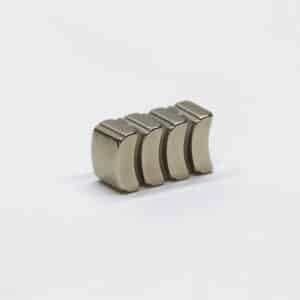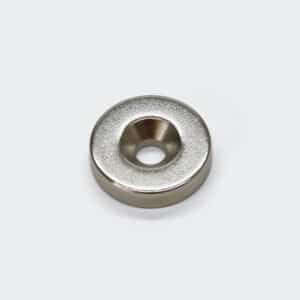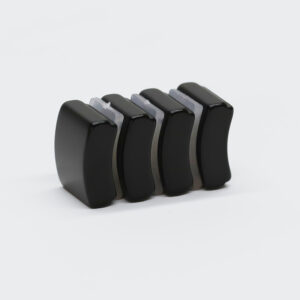


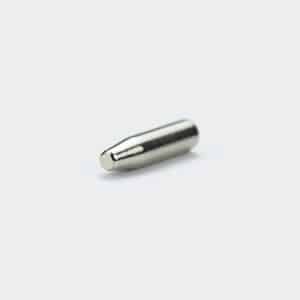
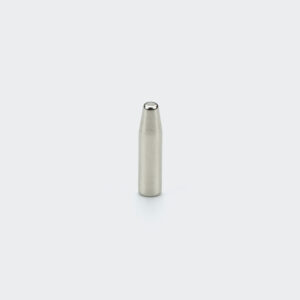
We offer custom tapered rod Neodymium magnets.
They come with cylindrical body that transitions to a conical or radiused nose.
The tapered tip provides two functions:
– Mechanical self-centering when inserting into a housing or receptacle.
– And flux concentration at the narrow tip.
– Useful for triggering Hall effect sensors or reed switches at greater distances.
Common in magnetic latches (cabinet doors, electronics enclosures).
And also position sensors, and probe assemblies.
We can manufacture using centerless grinding and profile grinding.
And maintain concentricity between the tip and body axis (typically ±0.05 mm or better).
The Engineering Logic: Why the Taper?
1. Self-Centering Alignment:
If you are designing a magnetic latch or connector:
The Problem:
– Flat-ended magnets require perfect alignment to mate.
– If they are slightly off-center, they hit the edge of the housing.
The Solution:
– The tapered nose acts like a guide pin.
– It corrects minor misalignments
– And guides the magnet smoothly into its locking position.
2. Flux Focusing (Sensor Precision):
The Problem:
– Standard rod magnets have a wide magnetic field spread.
The Solution:
– By narrowing the tip, the magnetic lines of flux are compressed into a smaller area.
– This increases the Gauss value at the tip.
– And provide a sharper, more precise signal for sensors or actuation points.
Geometric Definitions: Defining the Profile
To manufacture this, you need to define the “nose” geometry for us.
We customize the profile to your specific needs:
– Cylindrical Body: The straight section (Diameter & Length).
– Taper Length: How long is the sloped section?
Tip Style:
– Truncated Cone: Flat spot on the tip (as seen in the photo – best for durability).
– Full Radius: Perfectly rounded dome (best for smooth touch).
– Chamfered: A simple 45° angle cut.
Manufacturing Method (Precision Grinding)
Process:
– These are not molded.
– We take a standard sintered cylinder and grind the profile using diamond wheels.
Surface Finish:
– As shown in the photo.
– Our grinding process leaves a smooth surface that accepts plating perfectly.
– It doesn’t have the rough “machining marks” often seen on lower-quality ground magnets.
Magnetization Orientation
Axial (Through Length):
The standard orientation.
– Option A: Tip is North / Base is South.
– Option B: Tip is South / Base is North.
Note:
The magnetic field will be strongest at the tapered tip due to the geometric focusing effect.
Surface Coatings
Nickel (Ni-Cu-Ni):
– As shown in photo.
– Provides a hard, durable shell.
– The plating is applied after grinding to ensuring the tip is fully protected.
Parylene:
– Recommended for medical probes or sensors exposed to fluids.
Gold (Au):
– Ideal for electrical contact pins (Pogo pins).
Applications
Magnetic Latches: Self-aligning closures for cases and doors.
Fluid Valves: Plungers inside solenoids or check valves (the shape allows fluid to flow around it smoothly).
Sensors: Probes for detecting ferrous metal debris in oil (magnetic chip detectors).
Locating Pins: Fixtures that hold a steel part in a precise location for welding or assembly.
Ordering Guide: What We Need
To quote this, please provide a drawing or specify:
1). Body Diameter (OD): The thickest part.
2). Total Length (L): Overall height.
3). Taper Dimensions: Length of the cone section OR the Angle of the taper.
4). Tip Diameter: Is it a sharp point (fragile) or a flat spot (recommended)?
5). Pole Direction: Is the Tip North or South?