

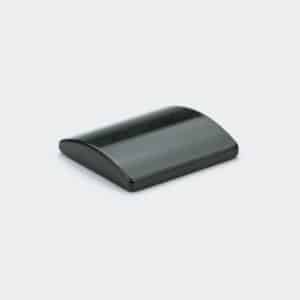
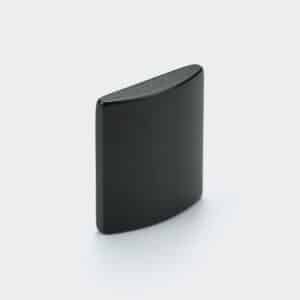
We supply custom plano-convex Neodymium magnets (also called “bread loaf” profile).
It is a rectangular block with a flat mounting base, vertical side walls.
And a radiused (arc-shaped) top surface.
This geometry provides a curved pole face.
And maintains a more consistent air gap distance when positioned around a cylindrical rotor or coil.
Compared to a flat block positioned on a curved surface.
Common in brushless DC motors, stepper motors, linear actuators.
And voice coil assemblies where magnets are mounted to a curved or cylindrical stator/housing.
Available with standard nickel plating or black epoxy coating.
Epoxy coating provides better corrosion resistance.
And it can reduce eddy current losses in some applications.
The radius of the top surface is typically specified to match your rotor diameter.
Or to provide a specific air gap profile.
The Engineering Logic: Curve & Coating
This explains the specific features seen in the photo (the Shape and the Color).
1. Optimized Air Gap (The Curve):
In a motor or generator, the distance between the magnet and the coil (the air gap) defines efficiency.
The Function:
– The top radius (R) of the magnet is ground to match the curvature of the housing or stator.
The Benefit:
– This maintains a constant, minimal air gap across the entire face of the magnet.
– It maximizes torque and efficiency compared to using a flat rectangular block.
2. Vertical Sides (Surface Mount):
The Function:
Unlike dovetailed magnets, these feature 90-degree vertical walls.
The Benefit:
This allows for tight packing (high fill factor) on the surface of a rotor. Magnets can be glued side-by-side with minimal gaps.
3. Black Epoxy Coating (The “Motor” Finish):
Why Black?
The magnet in the photo uses a Black Epoxy coating.
The Advantage:
– Epoxy provides 3x better salt-spray resistance than standard Nickel.
– More importantly, it offers better adhesion strength when bonding the magnet to a steel rotor, when you use industrial structural adhesives (Loctite/3M).
– Nickel is slippery; Epoxy grips.
Geometric Definitions: The “Loaf” Profile
We must clearly define the curve to properly manufacture it.
To quote this part, we control four critical dimensions:
1). Width (W): The flat bottom width.
2). Center Thickness (Tc): The height at the peak of the arch.
3). Edge Thickness (Te): The height of the vertical side wall.
4). Length (L): The extrusion length.
5). Radius (R): The curvature of the top.
Magnetization Orientation
Parallel / Diametric:
– The magnetic field lines run straight up and down (perpendicular to the flat bottom).
– Standard for SMPM (Surface Mount Permanent Magnet) motors.
Radial (Approximated):
– The field lines point toward the center of the radius.
Surface Coatings
Black Epoxy:
– As shown.
– The premium choice for glued motor assemblies.
Ni-Cu-Ni (Nickel):
– Standard, but less ideal for gluing.
Phosphated:
– A grey, chemical finish that is thinner than Epoxy but also bonds very well.
Applications
Linear Motors: The magnet track used in precision CNC machines and maglev transport.
Voice Coil Motors (VCM): Actuators in hard disk drives and loudspeakers.
Surface-Mounted Rotors: Brushless motors where magnets are glued to the outside of a steel hub.
Magnetic Bearings: Non-contact support systems.
Ordering Guide: What We Need
To quote this item, please provide a drawing or the following data:
1). Width (W)
2). Length (L)
3). Center Height (Tc)
4). Edge Height (Te) OR Radius (R) – If you give us Tc and Te, we can calculate the Radius for you.
5). Coating: “Black Epoxy” (as shown) or Nickel?