

Rated to 230°C (446°F), High Coercivity, Precision Concentricity
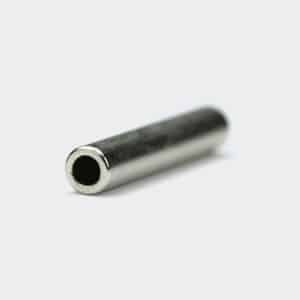
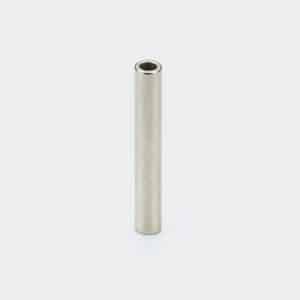
We supply Heat Resistant Neodymium Tubes for high-stress environments.
Standard Neodymium tubes (N-Grade) lose their magnetic properties at 80°C.
Meanwhile, our High-Temp Series can survive in the hot parts of your machinery, devices and housing.
No matter you are designing a Linear Motor, a Fluid Flow Sensor, or a Magnetic Coupling that fits over a hot drive shaft.
We supply tubes in H, SH, UH, and EH grades.
These magnets maintain their flux density and structural integrity.
Even when exposed to extreme radiant or conductive heat.
Why High-Temp Grades for Tubes?
A tube magnet is magnetically “stressed.”
Heat makes it worse.
1. The “Pc Value” Vulnerability:
The Physics:
A hollow tube has a lower “Permeance Coefficient” (Pc) than a solid rod.
This means the magnet is already fighting harder to retain its charge.
The Risk:
When you heat a magnet, you lower its resistance to demagnetization.
A tube is already “magnetically vulnerable” due to its shape.
It will fail faster than a block at the same temperature.
The Solution:
We recommend using SH (150°C) or UH (180°C) grades for tubes.
Even if your operating temp is only 100°C.
The extra Coercivity acts as a “buffer” to stabilize the hollow shape.
2. The “Hot Shaft” Factor:
The Application:
Tubes usually fit over shafts.
The Problem:
Drive shafts in motors or pumps generate friction heat and conductive heat from the rotor.
The magnet sits directly on this heat source.
The Benefit:
Our Heat Resistant grades ensure that the magnet doesn’t lose torque or signal strength.
Even when the machine warms up to operating temperature.
Magnetization Direction
Tubes function differently depending on the pole orientation.
Axial (Longitudinal):
Configuration:
North and South poles are on the flat ends (faces).
Use Case:
Linear actuators, reed switch triggers, and magnetic separators.
Diametric:
Configuration:
North and South poles are on the curved sides (3 o’clock and 9 o’clock).
Use Case:
Rotational motors and Hall Effect angle sensors.
Radial (Multi-Pole):
Configuration:
Multiple poles around the OD/ID.
Use Case:
Specialized precision motors.
Note:
Radial Sintered requires expensive tooling.
Diametric is the standard alternative.
Coating Advisory for Heat
The magnet survives the heat.
Meanwhile, you will also need to pick the right surface treatment.
Nickel (Ni-Cu-Ni):
Recommended for up to 200°C.
It may discolor slightly but remains functional.
Phosphating:
Highly Recommended.
It’s a chemical passivation layer (grey).
And it creates the best bond for gluing magnets to steel shafts.
It withstands high heat without peeling.
Epoxy:
Avoid this coating.
Standard Epoxy softens at 120°C.
Do not use Epoxy for high-temp tubes.
Ideal Applications
- Flow Meters: Magnetic tubes inside pipes measuring hot water or oil flow.
- Linear Motors: The stator magnet in high-speed linear actuators.
- Solenoid Plungers: Actuating pins in hot hydraulic valves.
- Magnetic Bearings: Non-contact support for high-speed shafts.
Ordering Guide: Precision & Specs
To quote these accurately, please define:
1). Dimensions: Outer Diameter (OD) x Inner Diameter (ID) x Length.
2). Target Temp: “What is the peak temperature of the shaft or environment?”
3). Magnetization: Axial or Diametric?
4). Shaft Fit: “Is this sliding over a precision shaft?”
– We can hone the ID to H7 tolerance if needed.
5). Coating: “Will you be gluing this?” (If yes, ask for Phosphating or Zinc).