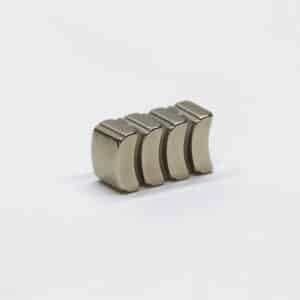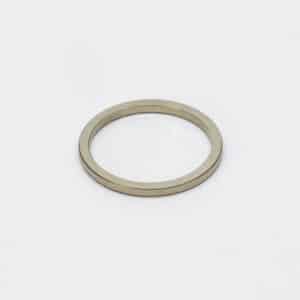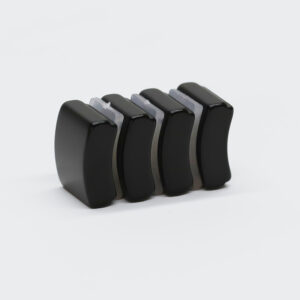


We supply custom arc segment Neodymium magnets with interlocking features.
– Notches, teeth, or grooves machined into the inner or outer radius.
These features enable mechanical retention by mating with corresponding geometry in the assembly.
The magnet can lock into notched stator laminations, key onto a splined.
Or, grooved shaft, or interlock with adjacent segments.
And then form a self-supporting ring without relying solely on adhesive.
Common in electric motor rotors and stators.
Particularly in high-vibration or high-temperature environments.
In such cases, adhesive-only retention may be insufficient.
The Engineering Logic: Why “Notched”?
1. Mechanical Locking (Anti-Rotation):
In high-torque motors or vibrating assemblies, glue can fail, causing magnets to slip.
The Solution:
– The notches act as physical keys.
– When fitted into a matching rotor or hub, the magnet is mechanically prevented from sliding or rotating.
The Benefit:
– Extreme reliability in high-stress environments without relying purely on epoxy bond strength.
2. Precision Alignment (Self-Fixturing):
The Function:
– The notches guide the assembly.
The Benefit:
– When assembling a segmented ring, the interlocking teeth ensure that every segment sits at the exact correct angle and distance.
– This eliminates human error during alignment.
Production Method: Wire EDM
Standard grinding wheels cannot cut these complex curves.
We need to make good use of EDM capability.
Precision Wire Cutting:
Zero Tooling Cost:
– Because we cut these shapes using a programmable wire, there is no need for expensive molds or dies.
– We can cut any custom notch pattern directly from your CAD file.
Tight Tolerances:
– EDM allows us to hold profile tolerances of ±0.03mm.
– This ensures a tight, “shake-free” fit when the parts are interlocked.
Magnetization Orientation
For interlocking arcs, orientation is critical for how they pair.
Diametric (Radial flux pattern):
– Common for motor arcs.
Alternating Poles:
– If you are building a ring from segments, we usually supply them in sets.
– E.g., Segment A is North-OUT, Segment B is South-OUT.
– So, they attract and lock together efficiently.
Surface Coatings
Coating complex notches requires attention to detail.
Nickel (Ni-Cu-Ni):
– As shown.
– We ensure the plating fully covers the inside of the notches.
Epoxy (Black/Grey):
– Highly recommended for interlocking parts.
– The epoxy layer is slightly compressible.
– It will help to prevent cracking when the “puzzle pieces” are snapped together.
Phosphated:
– For magnets being glued into steel laminations.
Applications
High-Speed Rotors: Where centrifugal force might detach a smooth magnet, but a notched magnet is physically locked in.
Modular Couplings: Magnetic drives that assemble like a puzzle.
Flywheels: Segmented magnetic rings that must withstand high G-forces.
Prototype Stators: Testing different motor geometries without building expensive molds.
Ordering Guide: What We Need
Standard dimensions do not work for this item.
We need:
1). 2D Drawing (DXF/DWG): This is mandatory. We need the vector file to program the Wire EDM machine.
2). Mating Part Info: “Does this fit into a steel part, or does it mate with another magnet?” (This helps us determine the tolerance gap).
3). Assembly Method: Will it be glued? (If yes, we leave a 0.05mm gap for glue).
4). Quantity: (EDM cutting is slower than slicing, so lead times may vary).