

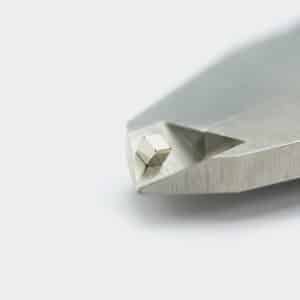
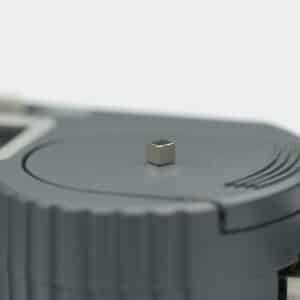
Micro-Precision (1mm³), Sharp Geometry, High-Grade N52
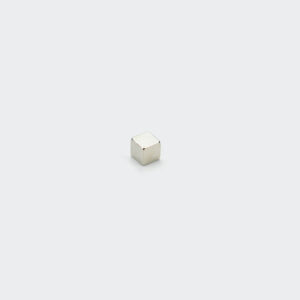
We supply precision dicing of Neodymium Micro-Cube Magnets, with side lengths down to 1.0mm.
These are not merely small magnets.
They are precision-engineered “magnetic pixels.”
And manufactured using semiconductor-grade dicing saws,
Our micro-cubes maintain sharp geometric definition and strict dimensional uniformity.
This allows engineers to stack, tile, or array them with zero air gaps.
Create high-density magnetic fields for micro-robotics, sensor matrices, and medical device actuation.
Why 1mm Cubes?
In the world of micro-engineering, the cube offers unique advantages over the disc.
1. The “Zero-Gap” Array (Tiling):
The Application:
– Building custom Halbach Arrays or magnetic tracks.
The Benefit:
– You cannot stack circles without wasting space.
– You can glue 1mm cubes side-by-side to create a continuous magnetic surface with changing pole vectors (Up-Right-Down-Left).
– They are the “Lego bricks” of magnetic field design.
2. 6-Axis Orientation:
The Application:
– Micro-sensors (IMUs) and Gyroscopes.
The Benefit:
– A 1mm cube is physically identical on all axes.
– This allows automated pick-and-place machines to orient the magnet’s polarity in any of 6 directions (±X, ±Y, ±Z) relative to the sensor.
– But you don’t change the mechanical footprint.
3. Flux Density in Micro-Volumes:
The Grade:
– At 1mm³, volume is your enemy.
– A standard N35 grade is too weak to be useful.
– We use Grade N52 for this size to maximize the holding force (approx. 0.35 lbs pull force) in the smallest possible package.
The “Corner” Challenge
Plating a 1mm sharp cube is one of the hardest tasks in the magnet industry.
1. Coating Integrity (Parylene vs. Nickel):
Nickel (Standard):
– Standard barrel plating can chip the sharp corners of a 1mm cube (tumbling damage).
– Or build up too thick on the edges (“dog-bone effect”), ruining the cube shape.
Parylene (Recommended):
– For strict 1mm tolerances, we recommend Parylene C (vapor deposition).
– It creates a uniform 10-micron layer that protects the magnet without rounding off the corners or altering dimensions.
2. Handling & “Jumping”:
The Reality:
– 1mm N52 cubes are incredibly “jumpy.”
– They will fly towards tweezers or other magnets instantly.
Our Solution:
– We highly recommend Tray Packing or Tape-and-Reel.
– Do not order these in a bulk bag.
– They will form a chaotic “magnetic ball” that is impossible to separate without tools.
Ideal Applications
Micro-Robotics: Actuation joints in insect-scale robots.
Medical Catheters: Steering elements in guide-wire tips.
Tactile Haptics: Creating pixelated magnetic fields for “feelable” buttons on touchscreens.
Lab Research: Custom magnetic field shaping for physics experiments.
Ordering Guide: Practical Logistics
To order these successfully, please consider:
1). Dimensions: Side length (e.g., 1.0mm, 1.2mm, 1.5mm).
2). The “Separation” Plan: “How will you handle them?”
– Bulk: Cheapest, but hard to handle.
– Tape & Reel: Best for automated assembly lines.
– Plastic Waffle Tray: Best for manual lab work.
3). Coating:
– Nickel: Shiny, conductive, but corners may be slightly rounded.
– Parylene: Matte, insulating, perfect geometric shape.