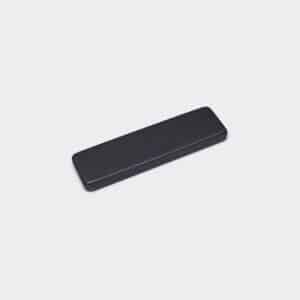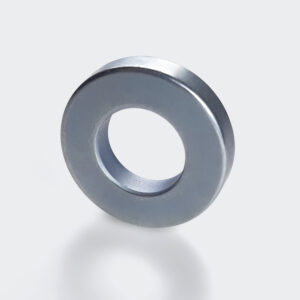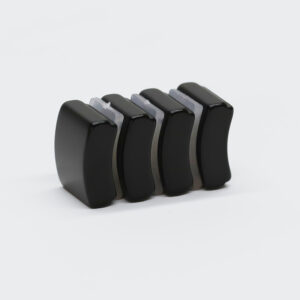


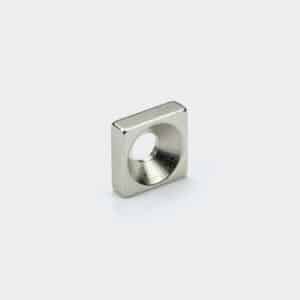
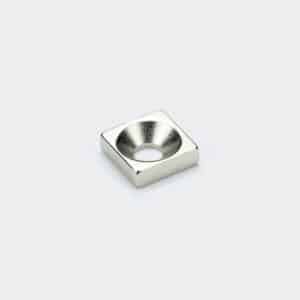
We supply square custom Neodymium magnets with a central countersunk hole.
It is a conical recess machined in the center of one face.
And it accommodates a flat-head screw for bolt-down installation.
The countersink allows the screw head to sit flush or slightly below the magnet surface.
So maintains a smooth magnetic face for direct contact with the target surface.
The square geometry provides flat edges that can be registered against a ledge, stop pin.
Or, a corner to prevent rotation around the mounting screw.
This enables repeatable positioning in fixtures, jigs, and assemblies where angular alignment is required.
Common in woodworking jigs, cabinet door catches, tooling fixtures, sensor mounting.
And any application requiring screw-mounted magnets with anti-rotation control.
Available with standard nickel plating or alternative coatings.
Countersink dimensions typically match ISO 7046 or DIN 963 flat-head screws (e.g., M3, M4, M5).
Magnetization typically through-thickness (perpendicular to the mounting face).
The Engineering Logic: Why Square?
1. Anti-Rotation & Alignment:
The Problem:
A round countersunk magnet secured by a single screw will spin if bumped or vibrated.
The Solution:
– A Square magnet has flat sides.
– If you mount it against a raised edge or inside a square pocket, it physically cannot rotate.
Aesthetics:
For square cabinetry or modern furniture, a square magnet visually integrates better with the linear lines of the design than a round disc.
2. Flush Mounting:
The Function:
The countersunk hole is drilled at a standard 90° angle.
The Benefit:
– This allows a flat-head screw (M3, M4, M5) to sit flush or slightly sub-flush with the magnet face.
– So it can ensure zero interference when the magnet makes contact with a steel plate.
Installation Advice: The “Torque” Limit
This is the most common failure mode for this product.
Preventing Cracks:
The area around the countersunk hole is the thinnest and weakest part of the magnet.
The Rule: Do NOT use a power impact driver.
The Risk: Excessive torque will split the square block in half instantly.
Our Tip:
Hand-tighten the screw until it is snug.
Use a “washer” or rubber gasket behind the magnet.
This extra item can help absorb shock and prevent cracking on uneven surfaces.
Polarity & Pairing (The “Matched Pair” System)
Critical for latch applications.
How are you using them?
Magnet-to-Steel: (e.g., Holding a tool to a wall).
Supply:
– Polarity is irrelevant.
– We supply standard stock (usually North on the face).
Magnet-to-Magnet: (e.g., A door latch where two magnets meet).
Supply: You need Matched Pairs.
Detail:
– We supply 50% with North on the countersunk face and 50% with South.
– This ensures they attract each other face-to-face.
Surface Coatings
Nickel (Ni-Cu-Ni):
– As shown.
– A durable, shiny finish. We ensure the inside of the hole is fully plated to prevent corrosion from the screw head.
Zinc (Zn):
– A matte grey finish, offering good corrosion resistance at a lower cost.
Epoxy (Black):
– Recommended for outdoor gates or humid environments.
Applications
Cabinetry: Heavy-duty door latches for square-design furniture.
Jigs & Fixtures: Holding steel parts on a workbench (the square shape allows for parallel alignment).
Concealed Closures: Magnets recessed into routed square pockets in wood.
Showroom Displays: Mounting graphic panels.
Ordering Guide: Critical Data
To quote this accurately, we need:
1). Block Size: Side Length x Thickness.
2). Hole Size: “Fits M4 Screw” or specific Major/Minor diameters.
3). Polarity: Do you need Matched Pairs (N/S) or Single Polarity?
4). Quantity: (MOQ applies for custom sizes).