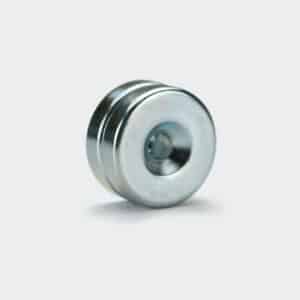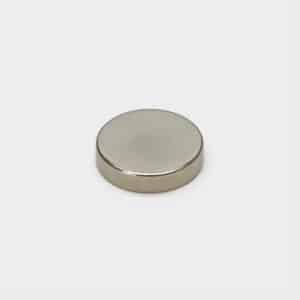


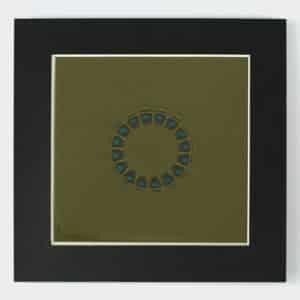
We supply precision-engineered custom 16-Pole Neodymium Ring Magnets.
They feature a high-density alternating polarity pattern (8 North / 8 South).
They are commonly used for applications requiring fine-grain control and detection.
Their 16-pole configuration doubles the resolution of standard 8-pole rings.
This high pole count generates 8 complete magnetic cycles per revolution.
So it is an ideal component for high-precision rotary encoders, smooth-running stepper motors.
And any sensitive haptic feedback controllers.
We can offer these in both Sintered Neodymium (for max holding force) and Bonded Neodymium (for perfect waveform shaping).
The Engineering Logic: Why 16 Poles?
1. High-Resolution Sensing:
The Math:
– A 16-pole magnet generates 8 sine waves per turn.
The Benefit:
– When paired with a high-speed Hall Sensor, this allows for exceptionally accurate position decoding (down to fractions of a degree).
– This is critical for Robotic Joints and Servo Feedback loops.
2. “Cogging” Reduction (Smooth Motion):
The Problem:
– Low pole counts (e.g., 4-pole) create a “jumpy” feeling (cogging) as the motor rotates.
The Solution:
– 16 poles create smaller, more frequent magnetic transitions.
The Benefit:
– The rotation feels silky smooth.
– This is essential for High-End Audio Knobs (volume dials).
– Or camera gimbals where vibration must be eliminated.
Material Selection: Sintered vs. Bonded
Option A: Sintered NdFeB (The Power Choice)
Pros:
– Maximum magnetic strength (N35–N52).
Cons:
– Difficult to magnetize cleanly on small diameters (<20mm).
– This is because the poles are too close together. Best for larger rings.
Option B: Bonded/Compression Molded (The Precision Choice)
Pros:
– Can easily achieve 16 (or even 32) poles on very small rings with perfect, sharp transitions between North and South.
Cons:
– Lower magnetic strength (approx MGOe 10-12) compared to Sintered.
Our Advice:
– If you need Signal Accuracy (Encoders), choose Bonded.
– If you need Torque (Motors), choose Sintered.
Magnetization Patterns
Axial 16-Pole (Face):
– The flat face is divided into 16 pie slices. Used for sensing and holding.
Radial 16-Pole (OD/ID):
– The poles are on the outer rim.
– Used for motor rotors.
Note:
Producing a solid Sintered Radial 16-pole ring requires expensive tooling.
We often recommend Bonded rings for this specific radial geometry to save costs.
Applications
Servo Motors: Feedback magnets for precise arm positioning.
Automotive: Steering angle sensors and seat position motors.
Haptics: Smart-dials in cars (infotainment knobs) that need a specific “click” feel generated by the magnet.
Robotics: Joint encoders.
Ordering Guide: Critical Data
To quote this, we need to assess the “Pole Crowding”:
1). Dimensions: OD x ID x Thickness.
2). Application: Sensor (Signal) or Motor (Torque)?
3). Material Preference: Are you open to Bonded Neodymium to achieve a sharper waveform?
4). Magnetization: Surface (Axial) or Edge (Radial)?