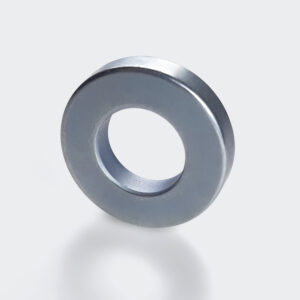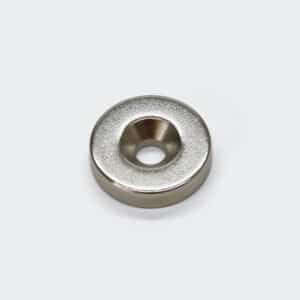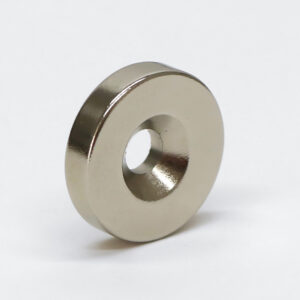


We supply custom 8-pole Neodymium ring magnets with alternating North and South zones instead of a single N/S pair.
The poles can be arranged on the flat face (axial multi-pole).
Or around the circumference (radial multi-pole), depending on your application.
Axial multi-pole rings are used in rotary encoders and position sensors.
As the ring rotates past a Hall sensor or magnetoresistive sensor, each pole creates a signal pulse.
More poles = higher resolution per revolution.
Common configurations are available: 4-pole, 8-pole, 12-pole, 16-pole.
Radial multi-pole rings are used in brushless motors and magnetic couplings.
Alternating poles around the outer or inner diameter interact with stator coils or a mating ring.
Provide smoother torque transmission than 2-pole configurations and enabling compact motor designs.
We produce these by assembling pre-magnetized wedge segments into a bonded ring assembly.
For production volumes, we can magnetize a single sintered ring using a multi-pole magnetizing fixture.
Provide your OD, ID, thickness, pole count, and orientation (axial or radial).
Why 8 Poles? (The Performance Advantage)
This section highlights why the customer wants this specific feature.
1. Enhanced Sensor Resolution:
For rotary encoders and speed sensors, a standard 2-pole magnet only provides one wave cycle per revolution.
The 8-Pole Benefit:
– Generates 4 complete sine-wave cycles per revolution.
– This allows Hall Effect sensors to detect speed and position with 4x the resolution of a standard magnet.
2. Concentrated Holding Force:
The 8-Pole Benefit:
– By alternating the poles on a single face, the magnetic flux path is shortened.
– It travels from N to S closely across the surface).
– This creates a “shallow but intense” magnetic field.
– Ideal for holding firmly against thin steel sheets where standard magnets would bleed through.
3. Torque Transmission:
The 8-Pole Benefit:
– In magnetic couplings, an 8-pole driver allows for higher torque transfer and “stiffer” locking compared to a 2-pole system.
Magnetization Patterns
You must distinguish between the two types of 8-pole patterns.
They are not interchangeable.
Type A: Axial 8-Pole (Face Magnetized)
Pattern: The flat circular face is divided into 8 “pizza slice” segments.
Appearance: Looks like a standard ring, but a viewing film reveals the 8 sectors.
Application: Rotary encoders, thin-wall holding, magnetic levitation stabilization.
Type B: Radial 8-Pole (OD/ID Magnetized)
Pattern: The poles are located on the Outer Diameter (OD) or Inner Diameter (ID).
Application: Brushless DC Motors (rotors), magnetic pump couplings.
Production Note:
– True radial multi-pole sintering is expensive.
– For cost-efficiency, we can also supply this as a “Bonded Neodymium” ring (isotropic) or an “Assembly of 8 Arc Segments”.
Manufacturing Methods
Producing an 8-pole pattern on Sintered Neodymium requires high-voltage pulse magnetization.
Monolithic (Single Piece):
– Use a specialized copper fixture to pulse the 8-pole pattern onto a solid ring.
– Best for high volume.
Segmented Assembly:
– For large rings (e.g., >50mm), glue 8 separate arc segments onto a steel carrier.
– Best for large prototypes or motors.
Applications
Rotary Encoders: Speed and direction sensing in robotics.
Micro-Motors: Stepper motor rotors requiring specific step angles.
Magnetic Catches:
– Low-profile latches for tablets/cases.
– Axial 8-pole holds strongly to the matching metal plate without damaging internal electronics.
Couplings: Hermetically sealed pump drives.
Ordering Guide: Critical Data
To quote an 8-Pole ring, we need to know:
1). Dimensions: OD x ID x Thickness.
2). Orientation: Is the 8-pole pattern on the Face (Axial) or the Edge (Radial)?
3). Sensor Type: Are you using a latching Hall sensor (requires square wave) or a linear Hall sensor (requires sine wave)?
4). Reference Mark: Do you need a physical mark on the “Pole 1” start point?