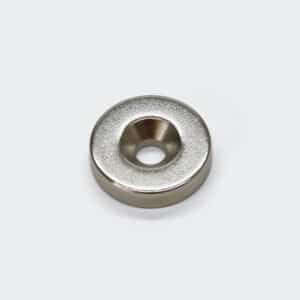


We supply custom 4-pole Neodymium ring magnets with alternating North-South-North-South zones in 90° segments.
The poles can be arranged on the flat face (axial) or around the circumference (radial).
Why 4-pole specifically:
In rotary encoders, 4 poles provide 4 pulses per revolution.
Enough for basic position detection while maintaining strong field strength per pole.
In brushless motors, 4-pole configurations allow 2-phase or 3-phase coil arrangements in compact diameters.
While 6-pole or 8-pole segmentation would make individual poles too small to produce adequate flux.
Primary applications:
– Rotary position sensors – Hall effect or magnetoresistive sensors detect the alternating field, providing quadrature signals for direction sensing
– Compact brushless motors – 4-pole radial rings in small-diameter motors (under 30mm OD) where higher pole counts reduce per-pole strength
– Magnetic couplings – 90° pole spacing allows torque transmission with self-centering alignment
We can produce these by assembling four pre-magnetized wedge segments (each 90°) and bonding them into a ring.
And, we can also magnetize a single sintered ring using a 4-pole fixture.
Provide your OD, ID, thickness, pole orientation (axial or radial), and expected quantity.
The 4-Pole Advantage: “Twist & Lock”
This is a unique application for 4-pole Axial rings that doesn’t apply to 8-pole rings.
Smart Mechanical Integration:
The 4-Pole Axial configuration (Face Magnetized) is the industry standard for Magnetic Twist-Locks.
How it works:
– When you mate two 4-pole rings together, they attract strongly in the aligned position.
– If you rotate one ring by 90 degrees, the poles repel.
Application:
– This allows for “Quick-Release” mounts (e.g., phone mounts, camera fixtures, or headphone cables) that lock securely.
– Meanwhile, release with a simple quarter-turn twist.
Magnetization Patterns
Clarify the difference between motor use and sensor use.
1. Axial 4-Pole (Face Magnetized)
Pattern: The flat face is divided into 4 “pizza slices” (90° each).
Best For:
– Twist-lock mounts, Hall effect sensors requiring 2 pulses per revolution.
– And hold against thinner steel (where 2-pole flux would waste energy passing through).
2. Radial 4-Pole (OD/ID Magnetized)
Pattern: 4 Poles alternating around the outer or inner circumference.
Best For:
– High-Speed BLDC Motors.
– A 4-pole rotor is capable of higher RPMs than an 8-pole rotor.
– Because the switching frequency (commutation) is lower, reducing eddy current losses.
Manufacturing Options (The Trader Solution)
Monolithic (Pulse Magnetized):
– A solid single ring magnetized with a specialized 4-pole fixture.
– Best for: Small rings (< 50mm) and high-volume production.
Segmented Assembly (The “bread-loaf” method):
– Instead of a solid ring, we glue 4 separate Arc Segments (90° each) onto a steel hub.
– Best for: Large motor rotors (> 50mm). Or, prototypes where building a custom magnetizing fixture is too expensive.
Applications
Consumer Electronics: “Twist-Lock” mounts for action cameras and smartphones.
Motors: 4-Pole Brushless DC (BLDC) motor rotors (common in drones and power tools).
Sensors: Speed sensing where 2 pulses per revolution are required.
Couplings: High-torque magnetic couplers for mixing equipment.
Ordering Guide
To ensure compatibility, please specify:
1). Dimensions: OD x ID x Thickness.
2). Orientation: Axial (Face) or Radial (Edge)?
3). Application:
– Motor: We will focus on high-temp grades (UH/EH).
– Holding/Locking: We will focus on N50/N52 for max force.
4). Construction:
– Do you need a solid ring, or can we supply 4 glued arc segments?
– Segments are often cheaper for large sizes.